A gift for a kid who hates reading (start by working out why)
A gift for a kid who hates reading (start by working out why)
Most gift guides for reluctant readers are book lists. This one starts with the question that decides everything: is the child unwilling to read, or unable to?
Work out which problem you have first. A child who won't read has a motivation problem, and the gifts that work are the ones that hand them control: a gift card they spend themselves, comics, audiobooks, or a book where they are the subject rather than the audience. A child who can't read comfortably has a skills problem, and no gift fixes that. Buying a book for that child is buying them homework with a bow on it. Skip the reward chart either way, because the research says paying children to read makes them like it less.
Every gift guide for this problem is a book list. Which is strange, because a book is the exact object the child has already told you they do not want.
The lists are not wrong so much as premature. They skip the step that decides everything, and it is a step you can do in about ten minutes over a weekend.
First: won't read, or can't read?
These look identical from the outside and they need opposite responses.
A reluctant reader decodes fine and understands fine. Hand them something at their level and they can read it and tell you what happened. They just would rather not. This is a motivation problem.
A struggling reader is finding reading itself hard, whether from dyslexia, a speech or language difficulty, or gaps in how they were taught. They are often reading below grade level and working much harder than their classmates for less. This is a skills problem, and it frequently looks like attitude, because avoiding something you are bad at in public is a rational thing to do.
The test is simple. Sit with them and something age-appropriate they have not seen before. Can they get through a page without much struggle, and then tell you what happened in it? If yes, you have a reluctant reader. If it is effortful, or they can decode the words but cannot tell you what the page was about, you are looking at something else.
Dr. Marie Carbo, founder of the National Reading Styles Institute, put the stakes bluntly in an interview with Reading Rockets: forcing a struggling reader through text that is too hard for them is experienced by the child as torture, and parents often assume that struggle means learning. Her line is worth keeping: reading is supposed to feel good to the child.
If it is a skills problem, the gift is not the answer. Ask the school for a reading assessment. Nothing you buy online will fix decoding, and a book-shaped present at that moment reads as one more person asking them to do the thing they cannot yet do. This is the most useful sentence in this article and it is the one no gift guide will tell you, because there is nothing to link to at the end of it.
Everything below assumes the first case.
Why nine years old is the moment
If the child in question is around eight or nine, you are not imagining it.
Scholastic's Kids & Family Reading Report tracks what they call the Decline by Nine. Among eight-year-olds, 57% read for fun five to seven days a week. Among nine-year-olds, that number is 35%. Over the same single year, the share saying they love reading falls from 40% to 28%, and the share calling reading extremely or very important falls from 65% to 57%.
Scholastic adds the uncomfortable part: they rarely see children rebound from those benchmarks as they get older.
This is not only an American pattern. The National Literacy Trust's 2025 survey of nearly 115,000 UK children found reading enjoyment at a twenty-year low, with just 32.7% of 8 to 18 year olds saying they enjoyed reading in their free time.
It matters more than it sounds. Following roughly 6,000 people in the 1970 British Cohort Study, Sullivan and Brown at the UCL Centre for Longitudinal Studies found that children who read for pleasure made more progress in vocabulary, spelling and even math between ages 10 and 16 than those who rarely read. The combined effect of reading habits at 16 was around four times greater than the advantage of having a parent with a degree.
So the thing you are trying to buy is not a book. It is the habit, and you have a narrow window.
The thing that actually moves the needle: choice
The single best-evidenced lever here is not a title. It is who picks it.
A meta-analysis of 41 studies by Patall, Cooper and Robinson found that giving people choice increased intrinsic motivation, effort, performance and perceived competence, and that the effect was stronger for children than for adults.
Children say the same thing about themselves. In the Scholastic data, 89% of children aged 6 to 17 agree that their favorite books are the ones they picked out themselves, and 88% say they are more likely to finish a book they chose. Scholastic's own summary of thirteen years of the survey: when kids get to choose, they read.
Which makes the best gift for a reluctant reader a very simple one.

A bookshop gift card and a trip to spend it. Not a book you chose. Not a book their teacher would approve of. Whatever they walk out with, including the one about farts, the one that is mostly pictures, the one you would not have picked. 42% of children in the Scholastic data say they have trouble finding books they like, which means the browsing is the gift as much as the money is.
What else works, and why
Comics and graphic novels. These get treated as a lesser form by adults and as a real book by children, which is the only opinion that matters here. They also solve the specific problem of a child whose stamina is low: the pictures carry the plot, so a bad page does not end the book.
Audiobooks. Listening is not cheating. For a child whose comprehension outruns their decoding stamina, an audiobook lets them meet stories at the level they can actually think at, which keeps the appetite alive while the mechanics catch up.
There is a wider roundup of gifts made from kids' artwork if you want options that are not books at all, which for this particular child may well be the right call.
Funny over worthy. In Scholastic's data, 52% of children say they want books that make them laugh, up ten points since 2016, well ahead of books that make them think and feel (25%). The gift that gets read is rarely the gift that would impress another adult.
A book where they are the subject, not the audience. This one needs explaining properly, and it is the one thing we make.
The case for a personalized book, stated honestly
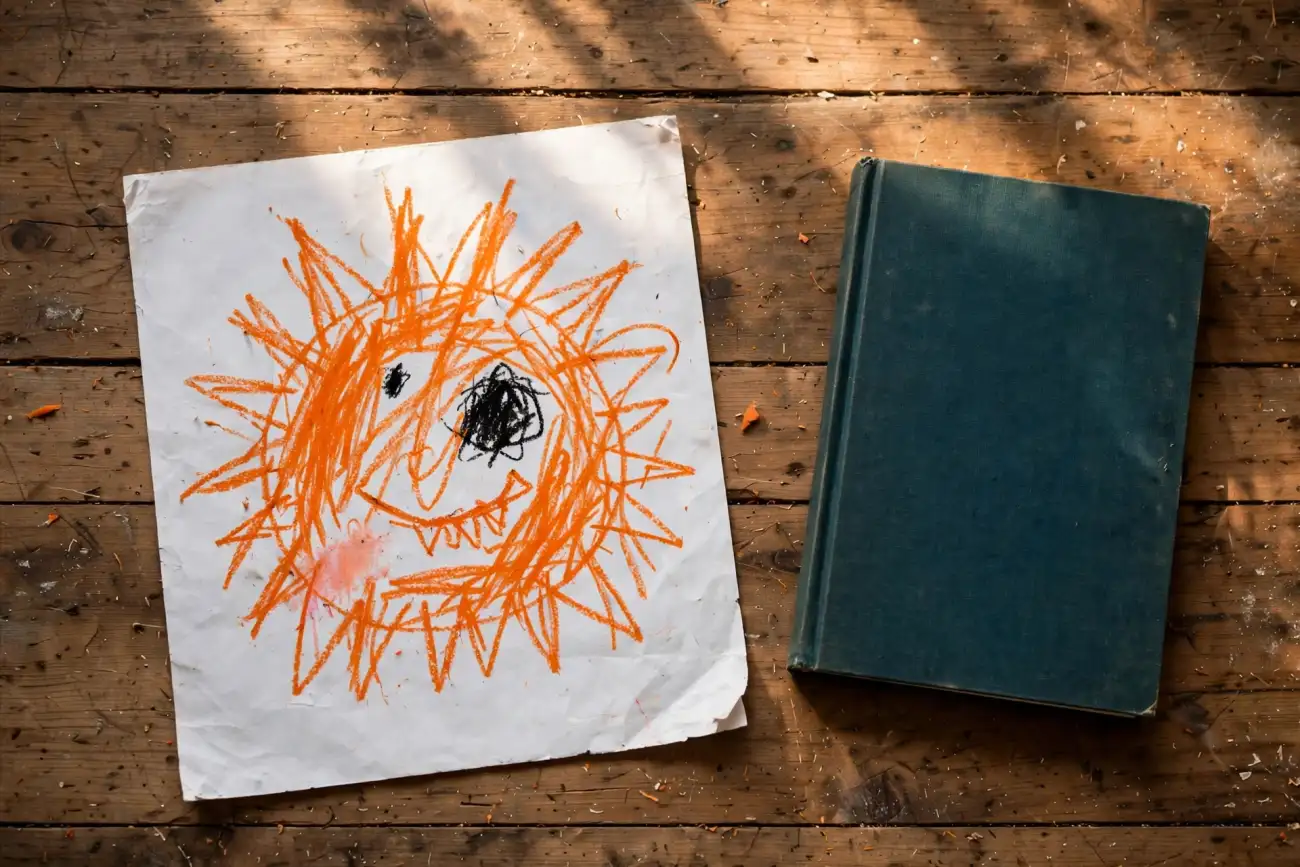
DoodleTale turns a drawing your child made into a printed storybook in which that drawing is the illustrated main character and the child is the named hero. A printed 8×8 inch softcover is $29.99 and a digital edition is $9.99, and you can see the whole book free before you decide.
The honest version of why that might help, including the parts that do not:
Research by Kucirkova, Messer and Whitelock observed parents and toddlers reading personalized versus non-personalized books at home and found significantly more vocal activity and significantly more smiles and laughter with the personalized books, with the children's smiles more often triggered by looking at the book itself rather than at the parent. Engagement with a personalized book held at a level statistically indistinguishable from the child's own favorite book. A later study found higher learning rates for new words contained in personalized books.
Now the limits, which come from the same researcher. Writing in Scientific American, Kucirkova reports that a separate experiment found no difference in children's comprehension of a story's moral across personalized and non-personalized versions, even though the personalized group gave more detailed retellings. More engagement did not mean more understanding. She also notes that children discussing personalized books talked mostly about their own feelings and experiences, and that parents had to work to steer attention back to other characters. And the first study above involved seven children. It is a real finding, not a large one.
So: a personalized book is not a reading intervention and we are not going to pretend otherwise. It will not teach a child to decode and it will not repair a comprehension gap.
What it can honestly claim is narrower and still worth something. It is one book that this specific child has a reason to open, at an age when most children are opening fewer, and it arrives without the thing that makes book-gifts land badly. A book chosen for a reluctant reader says I think you should read more. A book built from their own drawing says look what happened to the monster you made. The child is not being assigned it. They are the reason it exists.
That distinction is close to what Rudine Sims Bishop meant by books as mirrors, windows and sliding glass doors: a mirror lets a child see themselves reflected in a story rather than looking in at somebody else's. It is a concept rather than a measured outcome, and it is worth naming as such.
What to avoid
Reward charts, sticker systems, and paying per book. This is the most common thing adults reach for and the evidence is against it. Reviewing their meta-analysis, Deci, Koestner and Ryan found that tangible rewards, both material ones like pizza parties for books and symbolic ones like good-student awards, tend to undermine intrinsic motivation for the rewarded activity, and that the undermining is especially strong for school-aged children. Paying a child to read teaches them that reading is the kind of thing that requires payment.
Levelled books chosen for their level. If the number on the spine is the reason you bought it, it is a school gift wearing wrapping paper.
Anything that comes with an expectation attached. Reading specialist Timothy Shanahan, who led the National Reading Panel, puts it plainly in his advice for parents: being unpleasant, whether yelling, punishing or pressuring, does not work and is frustrating for everyone. A gift given with a hopeful look and a follow-up question next week is a form of pressure, however gently meant.
Where to start
Establish whether it is won't or can't. If it is can't, ask the school for an assessment and buy them something that has nothing to do with reading.
If it is won't, hand over the choosing. A gift card and an unhurried hour in a bookshop beats anything anyone else picks, including everything on this page. And if you want one object rather than a voucher, pick the one where they are the subject rather than the target, and then give it without a single question attached about whether they have read it yet.
If you are choosing for a particular age, there is a separate guide to what personalized books suit which ages, and one on whether personalized books actually help children read.
Try it yourself
Turn your child's drawing into a real storybook
Free preview. No account needed. Ships to US & Canada.
Start for free