How to encourage kids to draw more (without turning it into homework)
How to encourage kids to draw more (without turning it into homework)
Kids draw more when drawing feels like it goes somewhere. Practical ways to encourage drawing: draw alongside them, give the art a destination, stop asking "what is it?"
Kids draw more when drawing feels like it goes somewhere. The two moves that matter most aren't supplies or structure, they're drawing alongside your child without evaluating their work, and giving their art a real destination. A child who knows someone will do something with their drawing will keep making them.
Most advice about getting kids to draw more focuses on the setup: a new sketchbook, a better set of markers, a dedicated art corner with good lighting. These things can help. But they're not why a child picks up a crayon every afternoon for six months straight. That happens when drawing feels like it matters.
The parents who end up with a kid who draws constantly rarely did anything to engineer it on purpose. Looking back, what they usually did was respond to the drawing itself, not manage the supplies around it. That's the part worth copying.
Draw with them, not just near them
There's a real difference between sitting at the table while your child draws and actually drawing something yourself alongside them. When a parent picks up a crayon and makes their own picture, badly, enthusiastically, without visibly caring what it looks like, the whole energy shifts. The child stops performing and starts making.
Kids are very attuned to whether an activity is for their benefit or about their performance. Drawing alongside them signals that drawing is just something people do, not a skill you display on demand. In practice, children stay with a creative task longer when the nearby adult is a fellow participant rather than a judge.
You don't need to be good at drawing. A stick figure from a parent gets the same response as a masterpiece, sometimes a better one, because it gives the child permission to be imperfect too. Their drawings already are imperfect. Your imperfect one tells them that's fine.
One father started drawing dinosaurs next to his son every evening, always the same lopsided triceratops, always narrated out loud while he drew it ("this one has a bad knee, so he walks slow"). His son started narrating his own drawings back, inventing backstories for houses and animals that had never come up before. The drawing didn't get more detailed. It got more his.
Give their drawings somewhere to go
The single change that matters most is giving a child's drawing a real destination. "That's beautiful" is genuinely nice, but the conversation ends when the drawing goes into a folder. "We're going to make Grandma a book with this one" changes what drawing means for weeks.
DoodleTale turns a child's drawing into a real printed storybook, their art becomes the illustration, and they become the character in the story. For kids who know this is a possibility, drawing takes on a different weight. One parent described their 7-year-old starting to draw one picture a week after learning her drawings were being saved for her grandmother's birthday book. By the time the book was ready, she'd made enough for three.
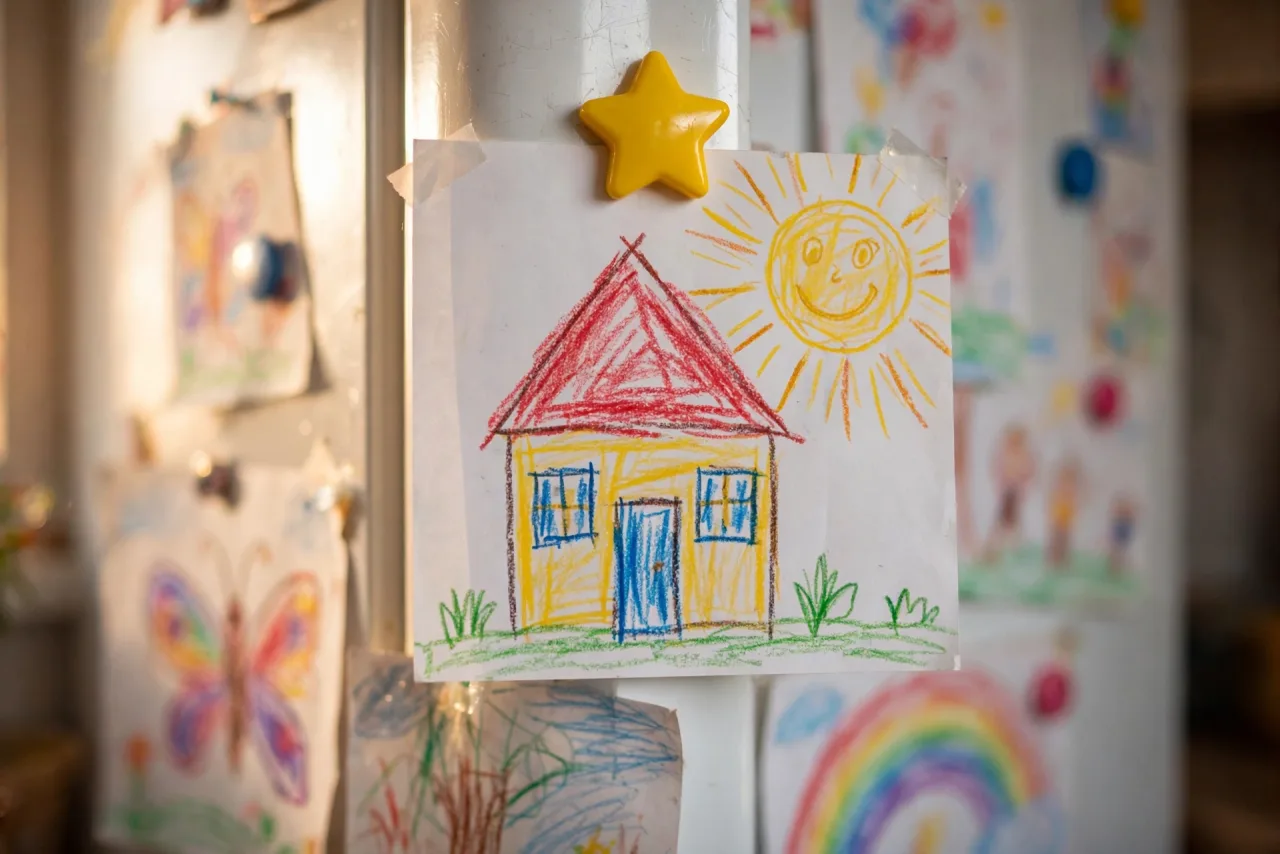
The destination doesn't have to be a printed book every time. A drawing going on the fridge matters more than most parents realize. A drawing going on a grandparent's fridge matters more still. What you're telling the child is that the drawing lives in the world beyond this table, that it affects other people, that it matters to someone other than you.
Stop asking "what is it?"
This one sounds minor and it isn't. "What is it?" puts a child in the position of defending or explaining their drawing, which immediately makes it feel like a test. Try "tell me about this" instead. It's an invitation, not an evaluation.
There's classic research underneath this. In a well-known Stanford study on children and drawing, preschoolers who were promised a reward for drawing later spent about half as much time drawing on their own, compared to kids who drew for no reason but their own interest. The lesson isn't really about prizes. It's that the moment drawing becomes about earning a response, a reward, a grade, a "good job" delivered like a verdict, the child's own reason for doing it gets crowded out.
So "you're so talented" teaches a child that drawing is about innate ability, which they either have or don't. "I love this part here, how did you decide to do that?" teaches them that choices and effort are what you notice. Children who believe drawing is a talent will eventually stop when the talent is questioned. Children who believe drawing is just something they do will keep doing it.
Also worth unlearning: coloring books as a drawing practice. Tracing and filling in shapes teaches children that there's a correct version of a drawing, which is the opposite of what you want. Blank paper and permission to fill it however they want is better.
None of this means coloring books are bad. They're fine for a quiet ten minutes in a waiting room. The distinction is just that they teach a different skill, staying inside someone else's lines, and shouldn't stand in for time spent making marks from nothing. A child needs both kinds of practice, but only one of them is drawing.
Build the habit through routine, not inspiration
Waiting for a child to "feel like drawing" is a strategy that mostly doesn't work. A short daily window, even 10 minutes after school with the crayons already out, removes the activation energy that makes starting hard. The table is already the drawing table. The question becomes what to draw, not whether to draw.
If your child gets stuck on "I don't know what to draw," a small bowl of prompt slips helps more than suggestions from a parent in the moment: "draw what you ate for breakfast," "draw something that surprised you today," "draw our house from outside." These give the hand somewhere to start without dictating what comes out.
Kids who consistently draw at the same time each day also tend to experiment more. The habit removes the performance pressure of a special occasion. It's just the thing that happens after school.
When your child draws the same thing over and over
Some kids land on one subject and stay there for months: the same dinosaur, the same rocket ship, the same family portrait with the same four figures in the same order. Parents often worry this means their child is stuck or bored. Usually it's the opposite.
Repetition is how a child gets good at something they've decided matters. Each version is a little more confident than the last, a slightly steadier line, a detail added because last time's version was missing it. A child who draws thirty near-identical rockets is doing the same thing an adult does when they cook the same recipe until they've got it exactly right, refining a thing they already care about instead of chasing something new. The variation is happening. It's just slower and smaller than parents expect to see.
If it feels worth nudging, the move isn't to suggest a new subject. It's to ask a question about the current one: "does this rocket go somewhere new this time?" or "who's flying it today?" That keeps the child in familiar territory while opening a door to something slightly different, instead of asking them to abandon what's working. Most kids move on when they're ready, on their own schedule, not because a parent introduced a new topic at the right moment.
Display their work like it means something
Displaying artwork is different from praising it. Display is a commitment, this piece mattered enough to put on the wall, and it's still there next week. Verbal praise fades. A drawing on the wall is a physical fact.
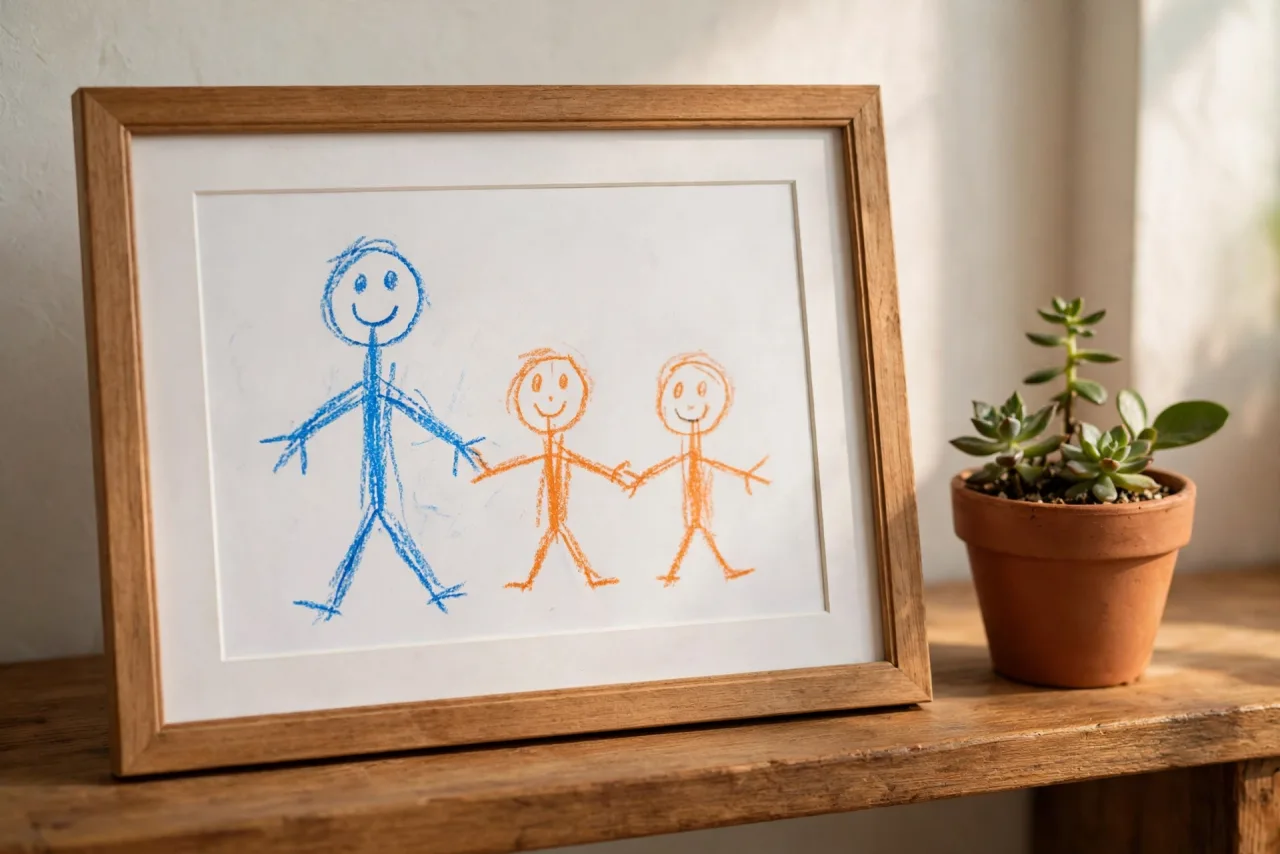
A rotating gallery wall with simple clips, a dedicated frame with a removable mat, or a printed storybook your child can hold, all of these communicate that the drawing has a life beyond the table where it was made. For a child deciding whether to keep drawing, that signal is worth a lot. And the drawings themselves are worth reading, not just displaying, what kids' drawings reveal about them is often more than parents expect.
When they're willing but stuck, a prompt bank beats encouragement. Things for kids to draw when they're bored is sorted by age and theme.
Frequently asked questions
Start by drawing alongside them, something, anything, without commenting on either drawing. "Can't draw" is usually "I'm afraid it won't look right," which dissolves when it's clear that looking right isn't the point. Kids who see adults draw badly and enjoy it tend to try more quickly than kids who receive encouragement alone.
Most children start making intentional marks between 12 and 18 months. Recognizable shapes, a circle for a face, lines for legs, appear between 2 and 3. By 4 or 5, many children are drawing detailed scenes from memory. There's wide variation in timing, and earlier isn't better.
Consistently, and across multiple domains. Fine motor control, spatial reasoning, narrative sequencing, and emotional processing all show up in children's drawing. A child working through something difficult will often draw about it before talking about it, which is real cognitive work even when it looks like play.
A rotating wall panel with simple clips works well, switch the art monthly so the display stays current. A dedicated frame with a removable mat makes it easy to swap drawings without reframing. For the ones you'd keep forever, photographing each in natural light preserves the record even if the original doesn't survive.
For the drawings that start to feel like keepsakes, the ones you'd keep forever, turning them into a printed storybook is the most durable way to give them a permanent home.
Kids who feel like their drawings matter keep making them. Everything else is just crayons.
Try it yourself
Turn your child's drawing into a real storybook
Free preview. No account needed. Ships to US & Canada.
Start for free