What your child's drawings are really telling you
What your child's drawings are really telling you
What kids' drawings actually reveal: their interests, how they think, and their developmental stage, not hidden problems. Plus why the scribble phase is worth saving.
Children's drawings reveal what a child is paying attention to, how they think about the world, and where they are developmentally, far more than they reveal hidden problems. Researchers can even read a child's growing knowledge from their drawings. The lopsided people and wobbly animals are a record of who your child is right now, which is exactly why one of them is worth keeping.
Every parent ends up with a drawer of them. A stack of drawings that mean something, but you're not quite sure what. Before the next pile gets recycled, it helps to know what these drawings actually show, and what they don't.
Two ways to read a child's drawing
There are two common ways to look at a kid's drawing, and only one of them holds up.
The first is the decoder approach: treat the drawing as a test, where dark colors mean sadness and a missing parent means trouble. It's everywhere online, and it's mostly wrong. As the team at Parenting Science puts it, drawings can reveal what kids are thinking and feeling, but they aren't trustworthy evidence that something is wrong.
The second approach is more useful and more accurate: treat the drawing as a window. Not into hidden pain, but into what your child notices, cares about, and understands right now. Read this way, a drawing tells you a lot.
What drawings actually reveal
Three things show up reliably in children's art.
The first is attention. What a child draws biggest, or places in the center, is usually what matters most to them at that moment. A family portrait where the cat is enormous and dad is a small head with legs isn't a slight against dad. It means the cat is the center of her world this week.
The second is how they think. In a 2024 Stanford study published in Nature Communications, researchers used machine learning to analyze about 37,000 drawings from children aged 2 to 10. They found that as kids get older, their drawings get more recognizable not just because their hands get steadier, but because of what they understand about the thing they're drawing. As the study's lead author Bria Long put it, "Just because your child isn't drawing something really well doesn't mean that they're not expressing interesting knowledge about that category." A barely recognizable tiger is still clearly an animal, and kids even convey how big something is in real life.
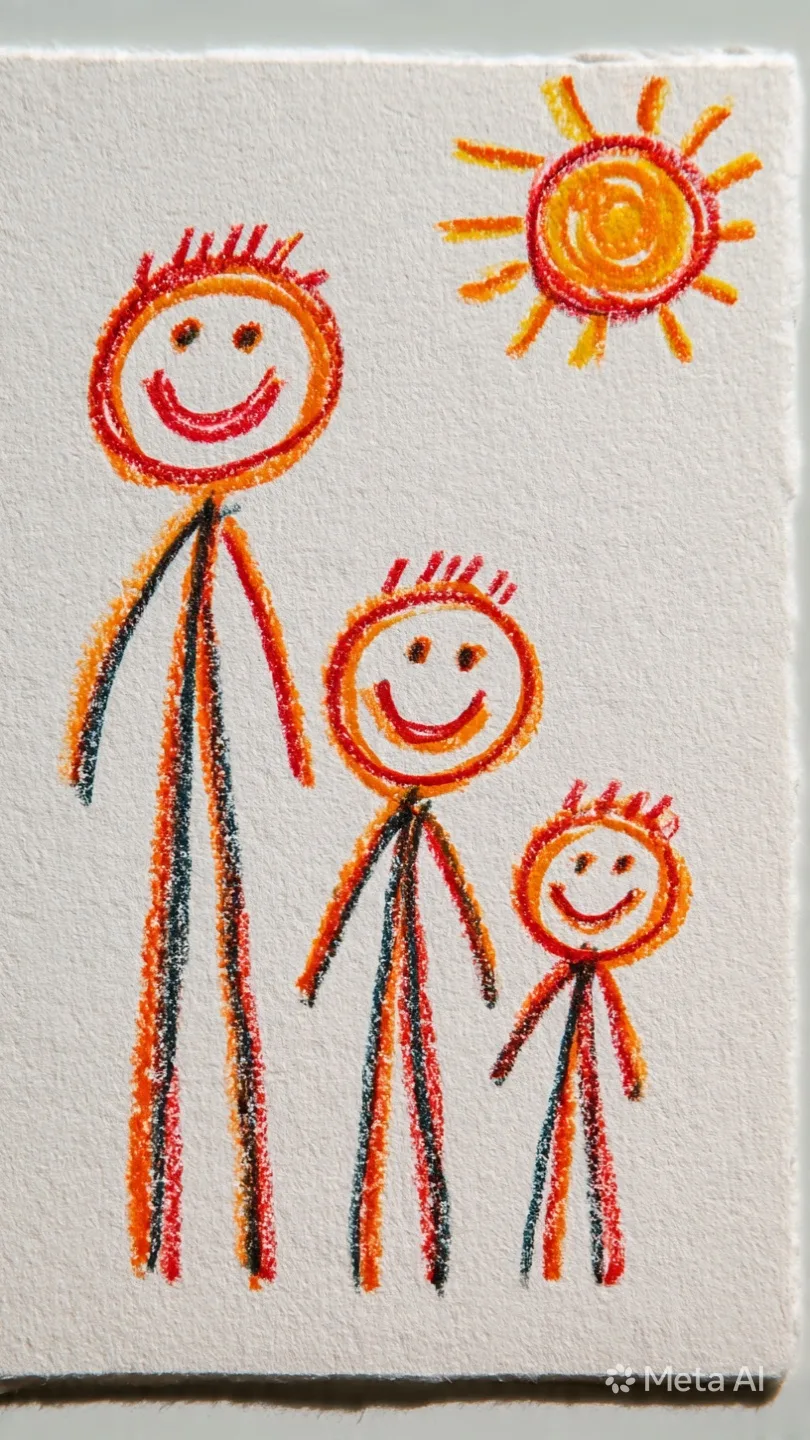
The third is developmental stage. Children's drawings progress through the same recognizable phases almost everywhere in the world: early scribbles, then "tadpole" people with legs coming straight out of a head, then figures that gain bodies and arms and detail. Where your child lands tells you roughly where they are, and every stage is normal.
The myth of decoding
It's worth saying plainly, because the internet is full of the opposite. One spooky drawing is not a warning sign. A kid who draws a monster with sharp teeth is usually a kid who thinks monsters are cool, not a kid in distress.
Color symbolism is the same. A child often reaches for black because it's the boldest line on the page, or for purple because it's their favorite this month, not because of their mood. Reading a drawing like a personality test tends to say more about the adult doing the reading than the child who drew it. If you ever have a real concern about your child's wellbeing, the answer is a conversation with a professional, not a checklist from a blog.
The most reliable way to understand a drawing is the simplest one: ask. "Tell me about your picture" gets you the actual story, which is almost always more interesting than anything you'd guess.
A real example
Picture a four-year-old who hands you a drawing of the family. The dog takes up half the page. Dad is a circle with two legs and no body. The sun is wearing sunglasses. There's a tiny purple blob in the corner she says is "the baby."
Decoded as a test, you might invent all sorts of things. Read as a window, it's clear and lovely: the dog is the most important member of the household right now, she's squarely in the tadpole-figure stage, she's having fun with details like the sunglasses, and she's thinking about her sibling even if she can't draw one yet. Nothing is wrong. A lot is being said.
Why this phase is worth saving
Here's the part that sneaks up on parents. Each of these stages is brief. The tadpole people of ages three and four are usually gone by six. The specific way your child draws a horse this year will never happen again. The drawing isn't just cute, it's a record of how your child saw and understood the world at one exact age.
That's why, out of a whole drawer, one drawing is often worth doing something real with. Most can be photographed and let go. The one that captures this moment, the one she explained to you with so much pride, is the one worth keeping in a form that lasts. Some parents frame it. Others turn it into a book: DoodleTale takes a single drawing and builds an original printed storybook around that exact character, so the wonky horse from this year becomes the hero of a story your child reads at bedtime. The drawing already tells a story. This just makes it a literal one.
What a drawing can tell you also depends on how old the child is, because a four-year-old and an eight-year-old are not attempting the same thing. Kids' drawing development stages sets out what changes and when.
Frequently asked questions
Years from now, you won't remember what their handwriting looked like at four. You will, if you keep one, remember exactly how they drew the family dog.
More on this: What to do with kids' drawings (the system that actually works) · How to preserve kids' artwork: 7 methods that actually last · Kids art book keepsakes: the one worth making · Do personalized storybooks actually benefit children?
Try it yourself
Turn your child's drawing into a real storybook
Free preview. No account needed. Ships to US & Canada.
Start for free