
Personalized storybook subscription vs. one keepsake book: which is worth it?
Personalized storybook subscription vs. one keepsake book: which is worth it?
Personalized book subscriptions vs. a one-time keepsake: what each really costs over a year, the forgotten-renewal problem the data shows, when a subscription is worth it, and when buying one book wins.
A subscription makes sense if you want a steady stream of new books and will keep up with it. But recurring boxes carry a real risk: in a 2022 C+R Research survey, 42% of consumers said they had stopped using a subscription but forgot they were still paying for it. For a gift, a milestone, or one book that's actually about your child, a one-time keepsake you buy once and keep tends to be the better fit than a monthly commitment.
"Personalized storybook subscription" sounds like the modern way to do it: a new custom book every month, always something fresh for your kid to read. For some families that's exactly right. For most people looking for one meaningful book, it's solving a problem they don't have.
The honest comparison isn't subscription versus keepsake in the abstract. It's what each one actually costs you, in money and in attention, and which matches what you're trying to do. That includes the cases where a subscription genuinely wins.
What "subscription" actually means for kids' books
Most kids' "book subscriptions" aren't personalized at all. They're curated boxes of already-published books, chosen for your child's age and interests. Literati runs about $9.95 a month for the membership plus the cost of any books you decide to keep. Bookroo is around $21.95 a month for a couple of board or picture books, shipped to your door.
These are lovely if what you want is a steady drip of new reading material. A curator picks titles you might not have found, and the box shows up like a small event. But the books aren't about your child. They're the same well-made picture books any subscriber that month receives, and your kid is the reader, not the hero.
Actually personalized recurring services are much rarer, and it helps to see where they sit in the wider field. Personalized storybooks come in four modes, and only one of them starts from something the child made. Name-based books (Wonderbly, Hooray Heroes) drop your child's name into a fixed story. Photo-based books (Magic Story, Pixozone) map your child's face into pre-drawn scenes. Text-prompt AI tools (Childbook.ai, Google's Gemini Storybook) generate a story from a sentence you type. And drawing-based books (Drawtopia, DoodleTale) begin with a picture the child actually drew.
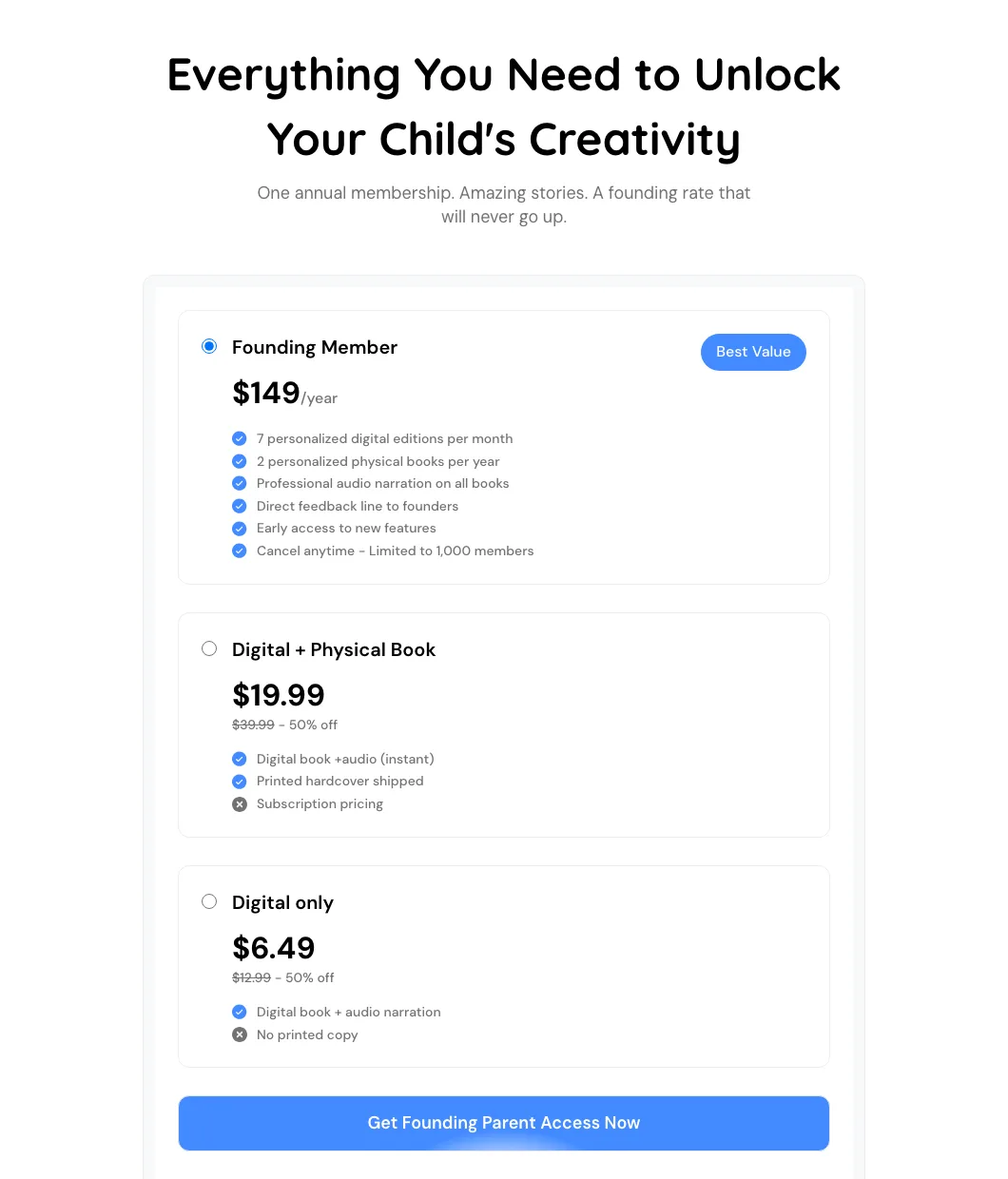
Almost all of those are sold one book at a time. The clearest personalized service that runs as a subscription is Drawtopia, which turns a child's drawing into an illustrated story and sells a membership at roughly $149 a year for a set of digital stories plus a couple of printed books. Notably, Drawtopia also offers a one-off digital plus printed book for $39.99, so even the one drawing-based subscription on the market gives you a buy-once alternative. A genuine personalized-storybook subscription exists, then. It just costs about the same as several individual books, paid whether or not you use it in a given month.
That last part is where the comparison gets real.
The real cost math over a year
Sticker prices hide the difference, because a subscription's number is per month and a keepsake's number is once. Line them up over a single year and the gap is larger than most people picture.
A curated box at the low end, around $9.95 a month, is roughly $119 a year for the membership before you've kept a single book. Add a few titles you want to hang onto and it climbs past $150 easily. A richer box like Bookroo at $21.95 a month is about $263 across the year. A personalized drawing-to-story subscription like Drawtopia lands near $149 annually. None of those is outrageous on its own; they're the price of a habit.
Now the other column. A one-off keepsake is a single purchase. A printed DoodleTale book is $29.99, or $9.99 for the digital version, and then it's done. There's no month two. So a year of a mid-tier box costs somewhere between four and nine times what one keepsake costs, and at the end of the subscription year you own a shelf of assorted titles, while at the end of the keepsake you own one book that's specifically about your child.
Neither number is "the right answer." They're answers to different questions. If the goal is a rotating supply of new reading, the per-month math is the point of the thing. If the goal is one book that matters, paying twelve times for eleven you didn't especially need is the expensive way to get there. It's worth doing this arithmetic honestly before you compare what a single book costs against a year of renewals.
The forgotten-renewal problem
Subscriptions have a well-documented failure mode, and it has nothing to do with the sticker price. People lose track of them.
In a survey of a thousand consumers, 42% admitted they had stopped using a subscription but forgot they were still paying for it (C+R Research, 2022). The same study found a striking gap between what people thought they spent and what they actually spent: asked to estimate their monthly subscription total, respondents guessed about $86, then, adding everything up, the real figure came to $219. That's more than two and a half times their own guess, a gap CNBC covered at the time. The problem isn't that any one box is expensive. It's that recurring charges are designed to be forgotten, and they usually are.
The churn data says the same thing from another angle. Deloitte's 2025 Digital Media Trends report found that 39% of consumers had canceled at least one paid subscription in the previous six months, with a large share saying the content simply wasn't worth the ongoing price. Subscriptions are easy to start and easy to forget. Increasingly, people are cutting them once the novelty wears off.
For a kids' book box, the forgotten-renewal risk has a particular shape. Reading interest ebbs and flows; a child goes through a phase of loving the monthly box and then a phase of ignoring it, while the charge keeps landing. Think of the four-year-old who was obsessed with the box in spring and has moved on to dinosaurs by summer, with three unopened envelopes stacked on the hall table and the payment still going out. Nobody decided to keep paying for a box the kid stopped reading; it just kept renewing while everyone was busy. None of that makes a book box a bad thing. It makes it a commitment, one that pays off only if you keep using it and keep noticing you're paying for it.
When a subscription genuinely makes sense
It would be unfair to paint every subscription as a trap. For the right family, a book box is one of the better things you can spend on, and the case for it is real.
The clearest fit is a child who reads constantly and burns through material faster than you can restock. If your five-year-old finishes everything in the house and asks for more, a curated box solves a genuine logistics problem: someone else is choosing good, age-appropriate titles and delivering them on a schedule, so you're never scrambling. The steady arrival can also build a reading habit, and it gives a kid something to look forward to that isn't a screen.
A subscription also earns its place when you're deliberately building a home library over time, or when the curation itself is the value. A parent who wants exposure to books they'd never pick themselves is buying discovery, not just paper. And for grandparents or relatives who want to stay present in a child's life month after month, a recurring box is a way to keep showing up.
The honest test is simple. A subscription is worth it when you'll open every box, when the child actually reads what arrives, and when you'll notice the charge enough to cancel the moment it stops being used. If those three things are true, the per-month math works in your favor and the forgotten-renewal statistic never applies to you. The trouble is that most people looking for one meaningful book don't have those three things. They have an occasion.
When one keepsake is the better buy
Set the recurring model aside and the choice gets clearer, because a keepsake and a subscription are trying to do different things.
A subscription is about volume: keep the new books coming. A keepsake is about one book that matters, usually because it's about the child, and it's meant to be kept rather than replaced next month. DoodleTale sits firmly on the keepsake side. It turns a single drawing into a printed storybook where the child's own art is the illustration and the child is the main character, bought one time, with nothing to renew or forget.
For most of the reasons people go looking in the first place, that one-off model fits better. A birthday or holiday gift is a single occasion, not a standing order. A milestone, a first drawing worth keeping, a grandparent's book, is a specific book, not a monthly stream. And a gift-giver can hand over a keepsake without quietly signing someone else up for a recurring charge they'll then have to remember to cancel, which is a strange thing to gift.
There's a durability point too. Parents who've ordered a book made from their child's drawing tend to describe the same thing months later: it's still on the shelf, it gets pulled out for visitors, it goes in the backpack. A curated box from last spring is mostly forgotten by autumn; the specific book about your kid isn't, because it can't be replaced by next month's version.
Picture the two most common reasons people go shopping in the first place. One is a sixth birthday where you want a gift the child will remember, not a subscription the parents will have to manage. The other is a first drawing you don't want to lose, the scribbled rocket or lopsided cat that suddenly feels worth keeping. Neither of those is a monthly problem. Both are a single, specific book, and paying once for exactly that book is cheaper and cleaner than starting a plan and hoping to cancel it at the right time.
The rule of thumb is simple. If you want a habit, a new book every month for a kid who devours them and a household that will keep up, a subscription can absolutely be worth it. If you want one book that's genuinely about your child and built to last, buy the one book. A keepsake you buy once and keep forever doesn't have a renewal date to forget. If you're still weighing which personalized book to make in the first place, comparing the main options side by side is the fastest way to land on the right one.
Where the market is heading (and why it doesn't decide this for you)
It's easy to read "the market is booming" as a reason to jump into whatever model is trendiest. The personalized children's book category is growing fast, but the firms tracking it disagree on the numbers by roughly a factor of two, so treat any single figure as one estimate, not gospel.
Business Research Insights pegs the global personalized children's books market at about $0.73 billion in 2026, projected to reach $1.5 billion by 2035 at a 10.4% annual growth rate. Data Bridge Market Research values just the U.S. slice at $661.49 million in 2024, growing to $1,128.52 million by 2032 at 7.1% a year. The takeaway isn't the exact dollar figure. It's that demand for books that make a child the hero is rising across both the subscription and the one-off sides, which means you'll see more of both marketed to you, and more reason to decide by your own situation rather than by whichever model has the louder ad.
If the keepsake side is where you are landing, the closest comparison worth making next is photo book vs. story book, because it decides which one gets reread rather than shelved.
Frequently asked questions
A few. Most 'book subscriptions' are curated boxes of published books picked for your child's age, like Literati (about $9.95/month plus the books you keep) or Bookroo (about $21.95/month). Truly personalized recurring options are rarer; Drawtopia, which turns a child's drawing into a story, runs a membership around $149 a year. Most personalized books, though, are still sold one at a time.
It depends on whether you'll use it and remember you're paying for it. Recurring boxes are great for families who want a steady stream of new reading and will actually keep up. The risk is the one the subscription data shows: in a 2022 C+R Research survey of 1,000 US consumers, 42% said they had stopped using a subscription but forgot they were still paying for it, so a box only pays off if you keep opening it.
A subscription delivers new books on a recurring schedule for an ongoing fee. A one-time keepsake is a single book you buy once and keep, with no renewal. The subscription is about volume and habit; the keepsake is about one book that matters, often personalized to the child, meant to last rather than be replaced next month.
Curated (non-personalized) boxes run roughly $10 to $22 a month plus the books you keep, so a year lands somewhere between about $120 and $260-plus. A personalized drawing-to-story subscription like Drawtopia is around $149 a year. A one-off keepsake such as a printed DoodleTale book is a single purchase at $29.99, with nothing to renew, which is why it suits gifting and milestones better.
When you want a habit rather than an object: a child who reads constantly and burns through new material, or a family building a home library over time. If you'll open every box and notice the charge, a subscription earns its keep. If you want one specific book, for a gift, a birthday, or a milestone, a one-time keepsake fits better.
For a book that's about your child and paid for once, a printed storybook made from their drawing is the keepsake worth owning outright instead of renting by the month.
A subscription is a bill that arrives every month. A keepsake is a book that's still on the shelf years after you paid for it once.
Try it yourself
Turn your child's drawing into a real storybook
Free preview. No account needed. Ships to US & Canada.
Start for free