Turn a drawing into a stuffed animal (and the keepsake most parents forget to compare it to)
Turn a drawing into a stuffed animal (and the keepsake most parents forget to compare it to)
How to turn a child's drawing into a stuffed animal, what it costs and how long it takes, plus the storybook keepsake worth weighing against a custom plush.
Upload a photo of the drawing to a custom-plush maker like Budsies, add a description, and an artist hand-sews a one-off soft toy, usually for around $99 to $150 and about six to eight weeks. It's a lovely keepsake to hug. Before you order, it's worth comparing it to a printed storybook made from the same drawing, which keeps the story instead of just the shape.
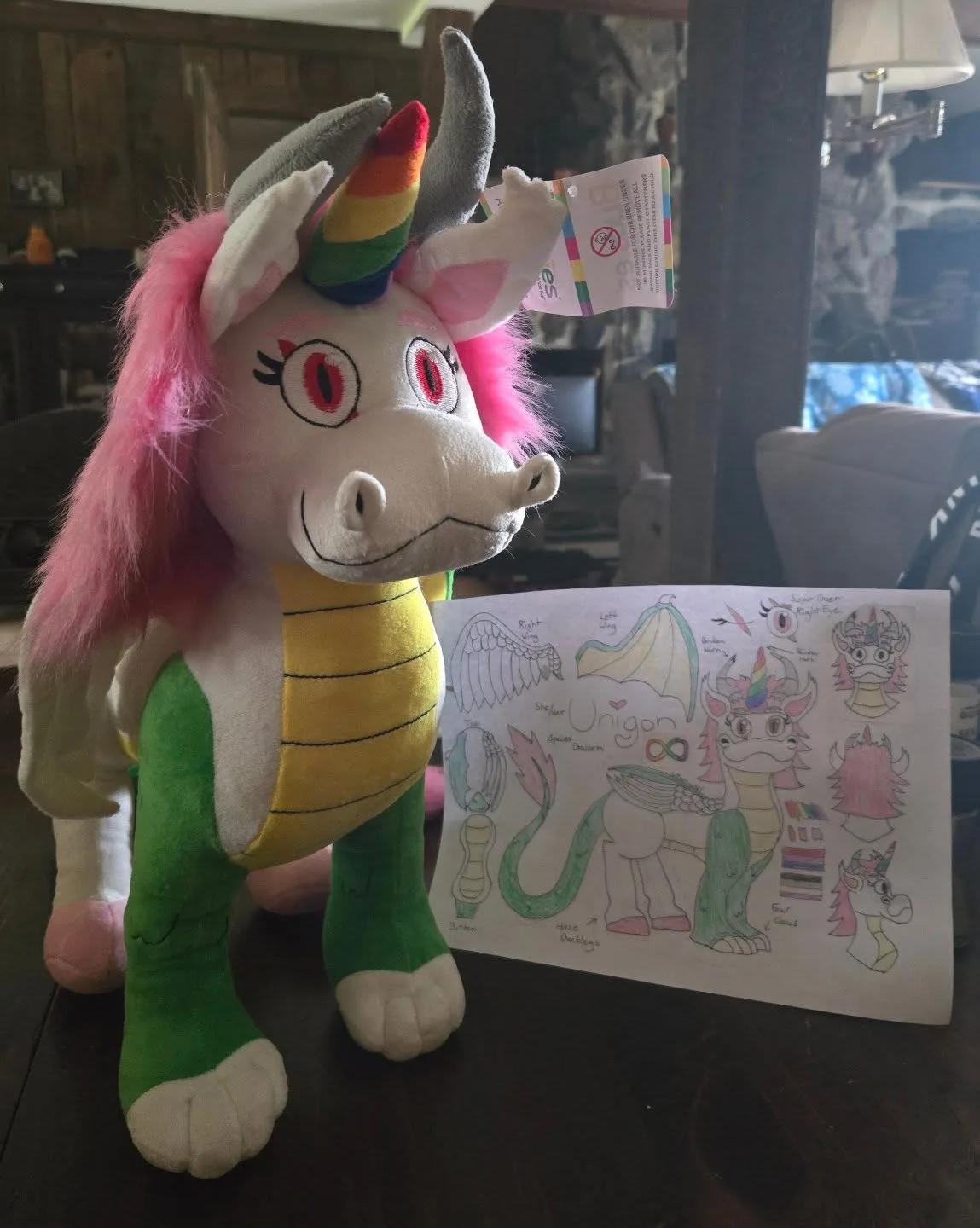
There's a particular kind of drawing that makes a parent think "I wish this could be real." A one-eyed monster with too many legs, a bird that's mostly triangle, a creature your kid named and gave a whole personality. Turning that drawing into a stuffed animal they can actually hold is one of the most charming things you can do with children's art.
It's also a bigger commitment than most parents expect, in cost and in wait time. Here's how it works, what it really costs, why a soft version lands so hard, and the one keepsake worth comparing it to before you order.
How turning a drawing into a plush works
The process is simpler than it sounds. You photograph or scan the drawing, upload it, and write a short description so the designers understand what's what, which blob is a foot, what color the fur should be, whether that scribble near the top is hair or a hat. Then an artist hand-sews a one-off plush based on it, and it ships to you weeks later.
The description step matters more than parents expect. A child's drawing is full of shorthand only the child fully understands, and the designer wasn't in the room when it was made. A line or two of notes, "the orange bit is a tail, not a leg," "she has exactly three teeth," is the difference between a plush that looks like the drawing and one that looks like a guess. Some services follow up with a proof or a mockup so you can approve the look before anyone starts sewing, which is worth using if it's offered.
The best-known service is Budsies, which has been turning kids' drawings into stuffed animals for years. Custom plush from a drawing generally starts around $99 and climbs toward $150 depending on size and detail, with a standard toy landing around sixteen inches tall and most makers offering an upsize if you want something bigger. Because every one is made by hand rather than mass-produced, turnaround runs about six to eight weeks, and longer in the run-up to the holidays.
That timeline is the part that catches people out. This isn't an add-to-cart, arrives-Tuesday purchase. If there's a birthday or a holiday attached to it, count backward on the calendar and order with real margin, because "made to order" means a person actually has to make it after you pay. A plush ordered in early November for Christmas is fine; one ordered in December is a gamble.
What it really costs, and why
Worth being clear-eyed about the number. Around $100 to $150 for a single toy is a gift-level purchase, closer to a nice piece of jewelry than to a trip to the toy aisle. The cost isn't markup for its own sake, it's the labor: someone is drafting a pattern from a five-year-old's scribble, choosing fabrics, and sewing a thing that has never existed before and will never exist again.
That one-off nature is the whole point and the whole price. A mass-produced teddy bear costs what it costs because a factory makes ten thousand identical ones. A plush of your kid's specific monster is a run of exactly one, which is why it costs what a small commission costs. If you go in expecting toy-store pricing you'll flinch; if you go in understanding it's a handmade keepsake, the number makes sense.
The 3D-figurine route
There's a related route worth knowing about: instead of sewing a plush, services such as Crayon Creatures 3D-print a small figurine from a child's drawing, turning the flat picture into a solid full-color object for somewhere around $150 delivered. It's a striking thing to hold, the drawing made physical in a way a photo never manages, and for the right recipient it's a genuinely lovely keepsake.
But one detail matters a lot if the recipient is little. These figurines are typically sold as decorative pieces, with the makers explicitly noting they're "not suited to be used as toys or to be given to underage children." They can have small parts and hard edges, and they're built to sit on a shelf, not survive a toddler. A plush is huggable and washable and made to be dragged around. A printed figurine is for the mantel, or for an older kid or an adult who'll treat it as the art object it is. Availability comes and goes, too, so if this is the route you want, check that the service is actually taking orders before you set your heart on it.
So there are really two physical routes from a drawing: the soft one you hug and the hard one you display. Most parents picturing a stuffed animal want the first, but it's worth knowing the second exists, and worth knowing it's not for small hands.
Why a stuffed animal hits so hard
The appeal isn't just novelty. A soft toy occupies a specific and well-studied place in a child's inner life. The pediatrician and psychoanalyst Donald Winnicott coined the term "transitional object" in 1953 for a child's first "not-me" possession, often, in his words, "a stuffed animal or soft blanket." It's the thing that helps a child feel safe moving from total dependence toward being their own separate person.
Winnicott was careful about what the object actually is. As he put it, "It is not the object, of course, that is transitional. The object represents the infant's transition from a state of being merged with the mother to a state of being in relation to the mother as something outside and separate." The plush isn't magic in itself. It's a placeholder a child uses to carry a feeling of safety out of a parent's arms and into the wider world, the babysitter's house, the first day of preschool, the dark bedroom at 2am.
These attachments are close to universal. In one long-running survey of young children, around 60% of American kids formed a strong bond with a toy, blanket, or similar object in their first few years. This isn't a quirk of a few clingy children, it's most of them. If you have a kid with a lovey they can't sleep without, you have a very normal kid.
Pediatricians treat this as healthy rather than something to discourage. The American Academy of Pediatrics is direct about it: "Despite myths to the contrary, transitional objects are not a sign of weakness or insecurity, and there's no reason to keep your child from using one." The AAP notes these objects work "in part, because they feel good: they're soft, cuddly, and nice to touch," and because the familiar item "has your child's scent on it, and it reminds them of the comfort and security of their room." A soft, cuddly, scent-holding object is, almost exactly, the design brief for a stuffed animal.
A plush made from a child's own drawing lands right in that emotional territory, and then goes one step further. The comfort object here is one they dreamed up themselves. The creature that helps them fall asleep came out of their own head, on their own afternoon, in their own crayon. That's a level of "mine" that a store-bought bear can't reach.
That's the real case for a custom stuffed animal. When it works, it's not a toy on the floor. It's a particular creature, from one afternoon, that your kid dreamed up and now gets to keep.
What a plush keeps, and what it doesn't
A stuffed animal preserves one thing beautifully: the shape. The character steps off the page and becomes something with weight you can carry around, squeeze, sleep on, and name for real. For a wish that's specifically "I want to hold it," nothing else on this list competes. But it leaves a few things behind, and they're worth naming before you spend $130 and wait two months.
It keeps the creature, not the drawing. The original wobbly lines, the exact way your five-year-old drew that leg, the too-big eye and the leaning smile, all of it gets translated into fabric and smoothed out in the process. A good plush maker captures the spirit of the character, but the specific marks of the specific hand are gone. What made it unmistakably your kid's drawing was partly the mistakes, and a stuffed animal, by its nature, tidies them.
It's also a single object, and single objects get loved hard. That's the point of them, but it's also the risk: the more a plush becomes the plush, the more catastrophic it is when it's lost, dropped in a puddle, or left at grandma's overnight. This is exactly why the AAP suggests buying two identical loveys where you can, so you can wash one and survive the loss of the other. You can't really do that with a one-of-a-kind handmade plush. There's one, and if it goes, it's gone.
And it captures the character without the story. The name, the backstory, the rules of its world, the whole narration your kid ran while they drew it, "he only eats blue things, and he's scared of Tuesdays," none of that travels into the stitching. The plush is the noun. The story your kid told was the whole sentence.
None of that makes a plush a bad choice. It just means "turn the drawing into a stuffed animal" answers one specific wish, the wish to hug it, and quietly leaves the others on the table.
The keepsake most parents forget to compare
Before ordering a plush, it's worth putting a second option next to it: turning the same drawing into a printed storybook. DoodleTale takes a single drawing and builds a real printed book around it, where the character from the child's drawing is illustrated on every page as the hero of the story. The original drawing is preserved, not re-sewn, and the character finally gets the narrative your kid always gave it out loud.
Look at what that keeps versus what a plush keeps. The plush keeps the shape and loses the lines, the copies, and the story. The book keeps the character recognizably theirs, shape, colors and quirks included, leaves the original drawing untouched, exists as a printed run you can order more of, and gives the character back its story on the page. It answers the parts of the wish the plush had to leave behind, the drawing itself and the world around it.
The practical differences matter too. A storybook keeps the drawing precisely as it was made, so the record of who your child was at five survives instead of being smoothed into felt. It turns around faster than a hand-sewn plush, which helps a lot when there's a birthday on the calendar and six-to-eight weeks is more runway than you have. And a book doesn't get left in a puddle the way a favorite toy does, it lives on a shelf, gets read at bedtime, and can be reprinted if it wears out.
How to choose (including doing both)
So the honest way to choose is by what you actually want to keep. If your kid needs a thing to hold at night, a plush is the right answer, and Winnicott would agree with the instinct, that's precisely the job a transitional object does. If what stopped you was the drawing itself, the specific lines, the character and its story, a book keeps more of it and keeps it faster.
A quick way to decide: if you found yourself wishing the creature were real so your child could hug it, order the plush. If you found yourself wishing the drawing itself would never fade, the exact marks, the name, the story your kid narrated, order the book. Most parents, if they're honest, feel a bit of both, which is why plenty of them do both.
Some parents do exactly that, the plush for the crib and the book for the shelf, because they preserve different halves of the same afternoon. The plush is the thing that survives being loved; the book is the thing that survives being lost. One goes to daycare and comes home filthy and beloved; the other stays home, unbent, and gets read a hundred times. Together they keep both the shape and the story.
Either way, it beats the drawing fading in a drawer, and there are other gifts you can make from a child's artwork worth weighing too, patches, prints, framed originals, each keeping a slightly different piece of the same small masterpiece. For one occasion the gift lists routinely miss, a flower girl or ring bearer keepsake, see personalized storybook gifts for weddings.
Frequently asked questions
You upload or mail a photo of the drawing to a custom-plush maker like Budsies, add a short description so the designers get the details right, and an artist hand-sews a one-off plush. It comes back weeks later as a soft toy version of whatever your child invented. The child doesn't have to do anything but keep drawing.
A custom plush from a drawing generally starts around $99 and runs to roughly $150 depending on size and detail, since each one is made by hand. A 3D-printed figurine from the same drawing lands in a similar range but is meant as a decorative object, not a toy. It's a real gift-level purchase, not an impulse buy.
Plan on about six to eight weeks, sometimes longer around the holidays, because these are made to order rather than pulled off a shelf. If you need a keepsake faster, or for a specific date, a printed storybook made from the same drawing turns around far quicker. Order early either way.
Just about. A single clear character works best, one creature, one figure, drawn big enough that its parts read. Very faint pencil, a whole busy scene, or several characters crowded together are harder to translate into one plush. When in doubt, a photo of the drawing on a plain background, taken in good light, gives the designers the most to work with.
The same drawing can become a framed print, a 3D-printed figurine, an embroidered patch, or a printed storybook where the drawing is the illustration and the child is the character. Each one keeps a different thing: the plush keeps the shape to hug, the book keeps the story. Which is right depends on whether you want an object or a keepsake to read.
For the invented creature you want to keep the story of, not just the shape, turning the drawing into a printed storybook preserves the whole thing your child made.
A plush keeps the creature. A book keeps the story. The best drawings are worth keeping both ways.
Try it yourself
Turn your child's drawing into a real storybook
Free preview. No account needed. Ships to US & Canada.
Start for free