A bedtime routine that actually sticks (and why most don't)
A bedtime routine that actually sticks (and why most don't)
Most bedtime routines fail because they are built for a good night. A routine that sticks has a shape: same order, getting quieter, ending in the same place. Here is how to build one.
Build it for your worst night, not your best one. A routine that sticks is short, always in the same order, gets quieter at every step, and ends the same way every time. Most routines collapse because they were designed on a calm Sunday and then asked to survive a Tuesday.
Every bedtime routine works for about eleven days. The bath, the pajamas, the two books, the song, the back rub, the second song. Then someone gets a cold, or a grandparent visits, or you get home at 8:40 with a child who fell asleep in the car for nine minutes and is now fully operational. The routine gets skipped. The next night it gets shortened. By the end of the month there is no routine, just a negotiation.
The problem is almost never discipline. It is design. Most routines are built on a good night, when you have forty-five unhurried minutes and a cooperative child, and then quietly assumed to be repeatable on every other kind of night. They aren't.
Design for the worst night you actually have
Write down your current bedtime routine, then ask one question about each step: can I do this on the night I get home at 8:40 with a tired, overstimulated child and no help?
Whatever survives that question is your real routine. Everything else is a nice thing you do sometimes, which is fine, but it shouldn't be load-bearing. The Sleep Foundation's guidance on bedtime routines makes the same point in gentler language: consistency does more work than content. A short routine you never skip beats an elaborate one you skip twice a week.
For most families aged 3 to 8, four steps is the whole thing. Something physical, teeth, something quiet and shared, and a fixed ending. Twenty minutes. That version runs on a Tuesday in February when everyone is sick of each other, and that's the entire point.
The order matters more than the contents
A routine isn't a checklist. It's a slope. Each step should be quieter, dimmer, and lower-energy than the one before it, so that the last twenty minutes of the day are continuously descending rather than bouncing.
This is where most routines leak. Bath, pajamas, story, then a tickle fight. Or story, then teeth, which means the child gets up, walks to a bright bathroom, looks at themselves in a mirror under a ceiling light, and arrives back in bed fully rebooted. The steps were all fine. The gradient was wrong.
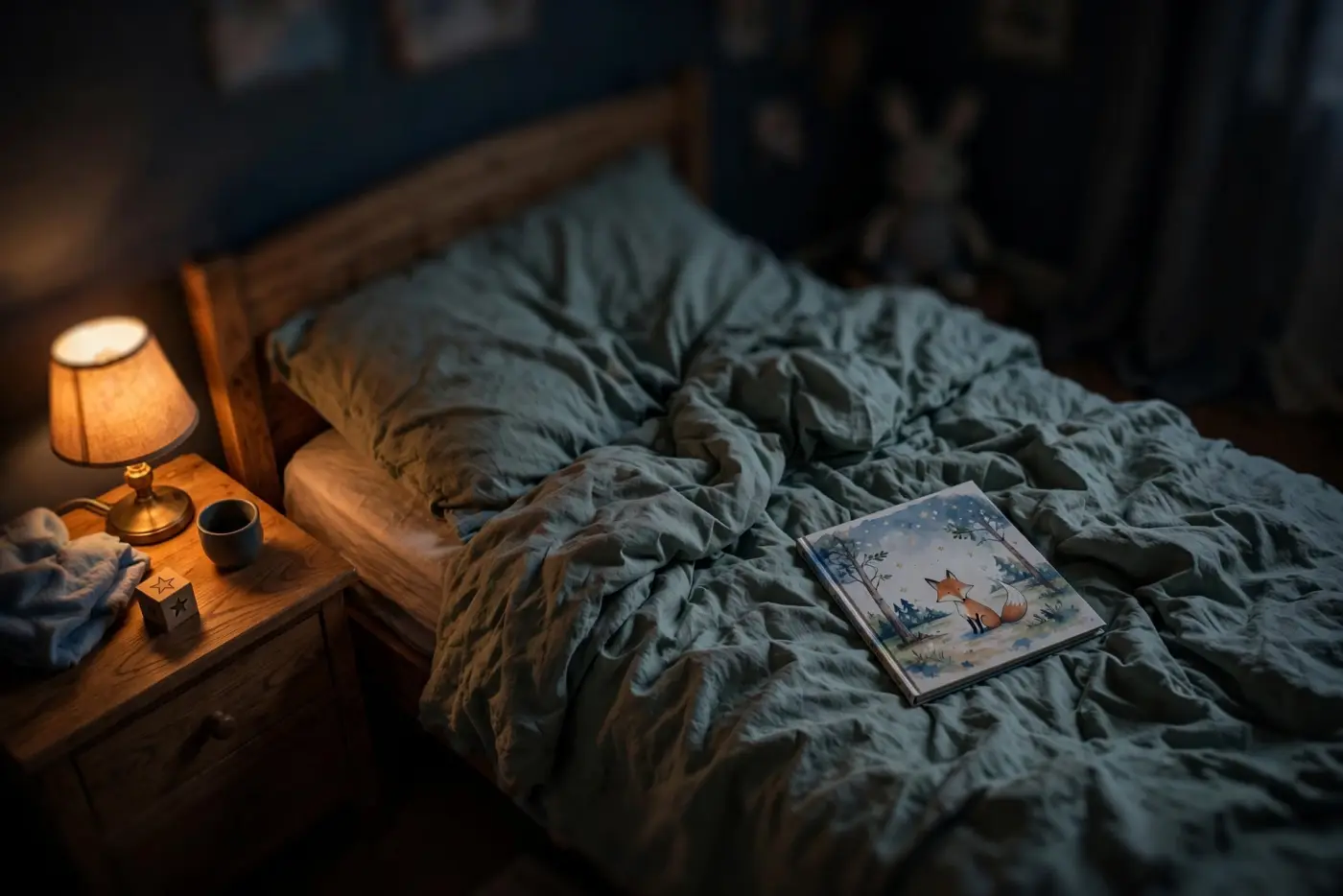
Put the brightest and most physical things first and the quietest thing last. Teeth before the story, not after. The story in the bedroom with the lamp on, not in the living room with the overhead light. The ending in the dark.
What we learned building a bedtime story generator
We build personalized storybooks at DoodleTale, and for a long time every book used the same underlying story shape, because it's the shape that makes stories good. A character wants something concrete. Something blocks it. They try three times and it gets worse each time. Then they do the thing that beats it, and the last page shows them changed.
That structure works. It is why Adventure and Funny books land. We tried it for bedtime books too, and it was actively bad. Parents were reading a story whose entire job is to raise tension three times in a row, to a child whose entire job in that moment was to stop being interested in anything. The better the story worked, the worse the bedtime went.
So bedtime got its own structure, which we still use. There is no conflict in it at all. There is a cozy place, named. There is one small concrete thing that is not yet right. There are two to four settling steps, and the rule in our own system is that each one has to be quieter than the last. Then there is a final image where the thing is right and the character is fully at peace. No obstacle, no climax, no triumph.
We didn't arrive at that from parenting theory. We arrived at it because the well-made version kept failing at the one job it had.
The same rule applies to the routine around the book. A bedtime routine is a story with a shape, and the shape is not want, struggle, victory. It is: here is where we are, here is the one small thing left to settle, here are the quiet steps, here is it being settled. If any step in your routine raises the energy instead of lowering it, it is in the wrong place, no matter how good it is on its own.
The ending has to be fixed, and it has to be boring
The last thirty seconds do most of the work. Same words, same order, same exit. "Lights off, I love you, see you in the morning." Then out.
A fixed ending isn't about being strict. It's about removing a question. If the ending is different every night, the child has a genuine reason to keep testing where it lands tonight, and stalling is the test. One more drink, one more page, one more question about whether sharks sleep. Those are almost never about water or sharks. They are bids for a little more of you, and they keep coming as long as the amount of you available is negotiable.
Give the bid a place to land inside the routine instead. A fixed two minutes of talking about the day, every night, before lights. Ask for one good thing and one annoying thing, so the two minutes have a shape and don't drift into a fourth story. Then the ending, which doesn't move. Children stop negotiating for things that reliably arrive on schedule, and a child who knows the talking is coming stops trying to manufacture reasons for it.
The book does more work than parents expect
The shared quiet step is where the routine either settles or unravels, and the book choice is most of that. A book a child genuinely wants to hear buys you a calm ten minutes. A book they're bored by turns the whole step into a second negotiation.
That is a harder problem than it sounds for children who have decided they don't like books. For them the story has to have something in it they actually care about before the calming can start. Kids who hate reading usually don't hate stories, they hate the performance of reading, which is a different problem with a different fix.
One thing that works unreasonably well is a book the child is inside. A DoodleTale book is built from a drawing your child made: the creature they invented becomes the illustrated character, and your child is the named lead of the story. When we set a book to the Bedtime vibe, it uses the settling shape above, so the story itself descends instead of building. You can see the whole thing free before deciding anything, and a printed 8 by 8 inch softcover is $29.99 with free shipping in the US and Canada, or $9.99 for the digital version.
What makes it fit bedtime specifically isn't the personalization. It's that a child will sit still for a story about their own drawing on a night when they won't sit still for anything else, and sitting still is the actual requirement of that step.
Reading levels, and why the wrong one wrecks the step
A story pitched too high turns the quiet step into work. A three year old handed a full paragraph per page stops tracking and starts moving. A seven year old handed one sentence per page notices, and being read down to is its own kind of insult.
Our books come in three levels for that reason: one to two sentences per page for ages 3 to 4, two to three sentences for 5 to 6, and a paragraph per page for 7 to 8. Whatever book you use, the check is the same. If your child's body is still by page four, the level is right. If they're negotiating by page four, it's wrong, and it's usually too high rather than too low.
What to do when it has already fallen apart
Do not rebuild the whole thing. Pick the last step and make it identical for a week. Same words, same order, same exit, no variation, including on the bad nights, especially on the bad nights.
Then add one step backward from there. Then one more. Building a routine forward from bath time means the fragile part, the ending, is always the part you reach when everyone is most tired. Building it backward from the ending means the part that matters most is the part that is already automatic.
Frequently asked questions
The drawings your child is making during the day are worth paying attention to on their own terms. What kids' drawings reveal about them covers what actually shows up in them, and turning one into a printed storybook is how one ends up in the bedtime rotation.
A routine that works on your worst night is a routine. Everything else is a good evening.
Try it yourself
Turn your child's drawing into a real storybook
Free preview. No account needed. Ships to US & Canada.
Start for free