Helping a kid with big feelings, when the words aren't there yet
Helping a kid with big feelings, when the words aren't there yet
Big feelings arrive before the vocabulary does. What to do in the moment, what to do after, and why the instinct to smooth a feeling into its normal version is the one to resist.
In the moment, name the feeling and stop talking. Do not reason with a flooded child, and do not shrink the feeling to match the size of the trigger. Afterward, give it somewhere to go: a conversation, a drawing, a story. The adult instinct is to smooth the feeling into a more reasonable version of itself, and that is the instinct worth resisting.
A four year old is on the kitchen floor because the cracker broke. You know the cracker isn't the issue. They don't know the cracker isn't the issue. Somewhere in there is tiredness, or a hard morning at preschool, or the fact that a friend said something at pickup, and none of that is available to either of you right now. What is available is the cracker.
Big feelings are not a misjudgment of scale. The feeling really is that big. What is missing is not perspective, it is the equipment: the vocabulary to name it, the working memory to hold it, and the practice of feeling something enormous and surviving it without doing anything about it. Adults have all three and forget that they were installed slowly.
Name it, then stop talking
The single most useful move is short and feels insufficient. Get low, lower your volume below theirs, and say what you see. "You wanted the whole one." "You were not finished." "That made you so angry."
Then stop. Do not add the lesson yet. Do not add "but we don't throw," which is true and will keep until later. A child in the middle of a flood can't process a clause that begins with "but," and adding one usually restarts the whole thing.
Naming works because it does two jobs at once. It tells the child the feeling is legible, which is the difference between being overwhelmed and being overwhelmed alone. And it hands them a word they did not have, which is the actual long-term project. A child who can say "I'm frustrated" at seven is a child who was handed the word at four, over and over, at a moment when they could not have produced it themselves.
Don't shrink the feeling to fit the trigger
"It's just a cracker" is the most natural sentence in the world and it does nothing. Worse than nothing, it teaches that the size of your reaction has to be justified to an adult before anyone will help with it.
The feeling is out of proportion to the cracker. It is usually not out of proportion to the day. Small triggers at the end of a long stretch of holding it together aren't irrational, they're the predictable place where holding it together stops. The American Academy of Pediatrics' material on emotional wellness makes the same point about young children and self-regulation: the capacity is under construction for years, and it fails first when the child is tired, hungry, or has been managing something hard.
Which means the useful question is rarely "why are they upset about this." It is "what have they been carrying since 7am."
Separate the feeling from what they did with it
The sentence that gets this wrong is "you're not angry." The sentence that gets it right is "you're allowed to be that angry, and you're not allowed to hit your sister."
Children collapse these two things constantly, and so do a lot of adults. If being furious gets you sent to your room, the lesson learned is that fury is the offense. The child doesn't stop being furious. They get better at concealing it, which looks like progress for about four years and then doesn't.
Holding both halves at once is harder than it sounds, because in the moment the behavior is the urgent part and the feeling is the abstract part. It helps to say the halves in a fixed order, feeling first, every time. "You are so angry that she took it. You can't hit her." Two sentences, no "but" between them, because "but" deletes whatever came before it.
Over a few years this builds a distinction that most of the rest of emotional development rests on. Feelings are not a behavior, are not negotiable, and are not something you can be in trouble for. Actions are all three. A child who has that split clearly by seven has something to work with when the feeling arrives and the adult isn't in the room, which is the actual test and the one you will not be present for.
A useful side effect: it gives you something to say that is both honest and not a concession. You are not telling a furious child they are wrong to be furious, which they would not believe anyway, and you are not letting the hitting stand.
The work happens afterward, not during
Nothing you teach during a meltdown gets learned. The teaching window opens ten or twenty minutes later, when they're back, usually quiet and a little embarrassed, often leaning on you.
That is the moment for the short version. What happened. What it felt like in their body. What they want to do about the thing they knocked over. Keep it brief and unembarrassing. A long post-mortem turns a feeling into a court case, and children who expect a trial get better at hiding evidence rather than better at regulating.
Drawing is a side door
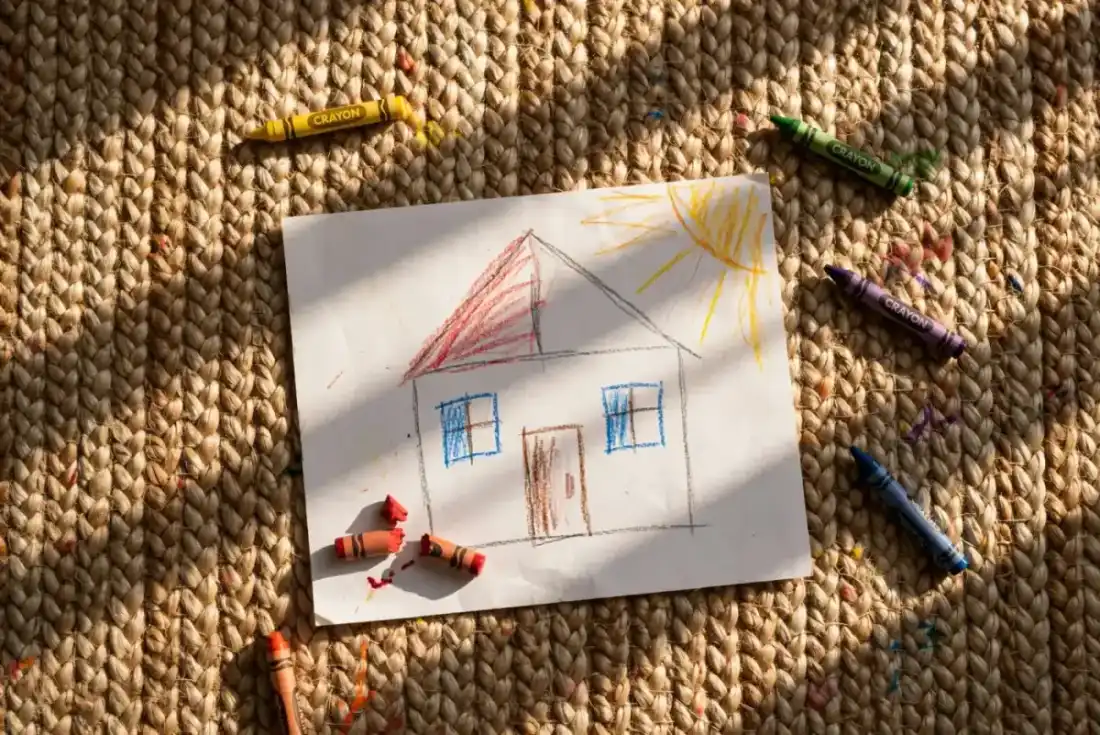
Plenty of children will tell you nothing at all and then draw the entire thing twenty minutes later. A house with no door. A very small figure next to a very large one. The same storm over and over for a week.
This is worth taking seriously without over-reading it. A drawing is a door, not a readout, and the decoding industry around children's art is mostly unreliable. What your child's drawings are really telling you goes into where the line sits between noticing and diagnosing. For the purposes of a hard week, the useful version is simple: ask about it, don't interpret it out loud, and let them narrate.
"Tell me about this one" gets more than "why is he so small?" The first is an invitation. The second is a theory the child now has to agree or disagree with, and most children will just agree.
What we learned by not correcting children's drawings
We build personalized storybooks from children's drawings, which means we spend a lot of time watching an AI model look at a five year old's crayon lines. The default behavior of every model we tried was the same, and it's worth describing precisely, because it's exactly the adult instinct with feelings.
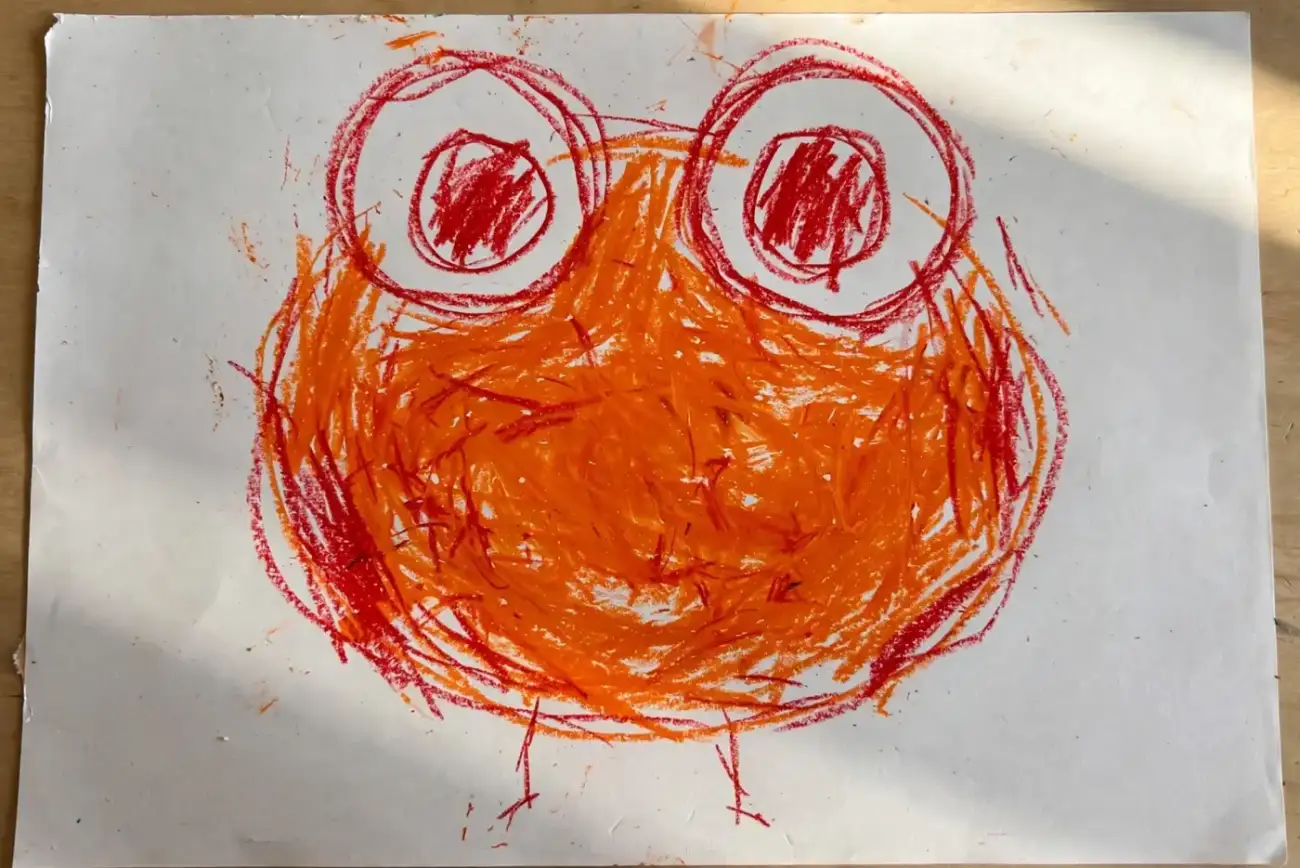
Hand a model a child's drawing of a lion. The body is enormous and the legs are thin sticks. The eyes are on the front of the face and much too big. The mane is a row of short lines on top of the head. The model will return a lion. A good one, beautifully rendered, correctly proportioned, and completely unrecognizable to the child who drew it.
So our system now has an explicit step that does nothing but catalog the ways the drawing departs from the real animal, and a rule that those departures are the creature's actual anatomy. Bottom-heavy, stick legs, front-facing eyes, mane as a row of lines. Not errors to be corrected on the way to a proper lion. The whole specification. The instruction in our own pipeline is that the output must not look like a normal version of the animal.
We wrote that rule because the polished version kept failing. Children did not recognize the improved lion as theirs, and the improvement was the reason.
The same move applies to a feeling. The adult instinct is to render the child's enormous, badly proportioned, strangely colored emotion into the reasonable version of itself, the one an adult would have had about a cracker. It is meant kindly and it produces the same result: a correct rendering the child doesn't recognize as theirs. The wonky proportions are the message. They are the part that tells you how the day actually went.
Give the feeling somewhere to go
Feelings that get named and then have nowhere to land tend to come back the same way. A destination helps, and it doesn't have to be elaborate: telling the story of the day at dinner, drawing it, or putting it in a book.
That last one is what we do at DoodleTale. A child's drawing becomes the illustrated character, kept with its real proportions, and your child becomes the named lead of an original story about it. Books come in three reading levels for ages 3 to 8, and you see the whole book free before deciding anything. A digital copy is $9.99 and a printed 8 by 8 inch softcover is $29.99 with free shipping in the US and Canada. There are four books about feelings to read through, each one starting from a different drawing.
The reason it does anything for a child working through something is not the personalization. It is that the strange creature they invented during a hard week gets treated as worth printing, exactly as drawn, by someone other than their parent.
Frequently asked questions
Children who have stopped drawing often stopped because it started being evaluated. How to encourage kids to draw more covers getting the habit back without turning it into an assignment.
Name it, don't shrink it, and let the strange proportions stand.
Try it yourself
Turn your child's drawing into a real storybook
Free preview. No account needed. Ships to US & Canada.
Start for free