Why does my child draw the same thing over and over?
Why does my child draw the same thing over and over?
Why does my child draw the same thing over and over? Usually it is practice, comfort, or a story world taking shape. What each age looks like and when to look closer.


Turn your child’s drawing into a book
Free preview, no account needed.
Usually because they are getting better at it. Children repeat a favorite subject to refine a shape they care about, to enjoy something predictable in a world where most things are decided for them, and, from about age five, to run a story world around a character they invented. Follow the subject rather than steering away from it, and change the situation instead. Repetition is only worth a closer look when it crowds out other play or comes with real distress over small changes.
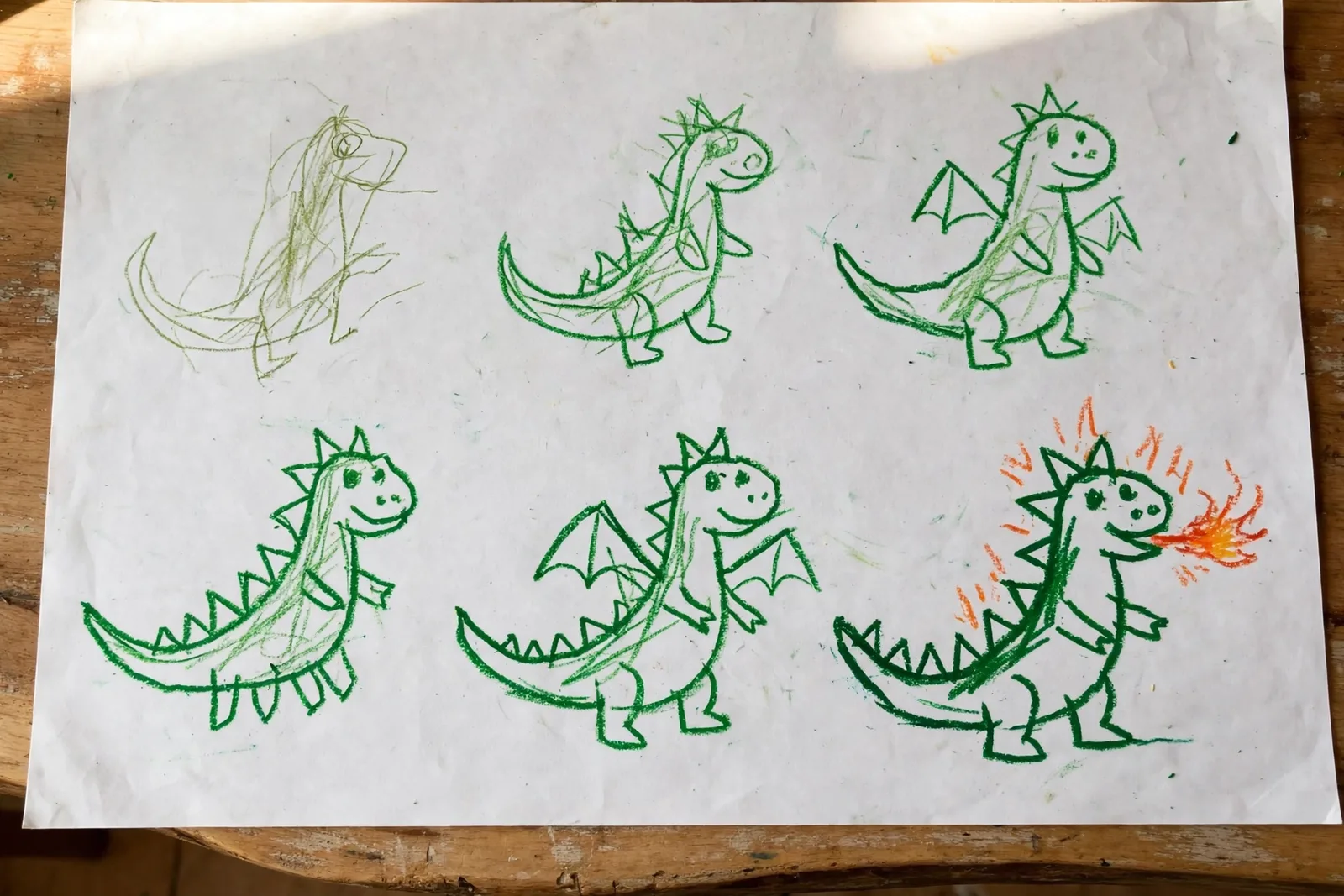
Your daughter has drawn the same green dragon forty times this month. Your son puts the same house with the same crooked chimney on every page. The fridge has become an archive of one subject, and you have started wondering whether this is a phase, a fixation, or something you are supposed to be doing something about.
Almost always, it is a phase, and one of the more useful ones. Dav Pilkey was sent out to the hallway so often in elementary school that, according to his publisher's biography, it was there "where he created comic books about superheroes" that "eventually became Captain Underpants and Dog Man." He kept drawing those superheroes. Most children who do this will not become bestselling authors. Nearly all of them are doing something worthwhile.
What repeated drawing is actually doing
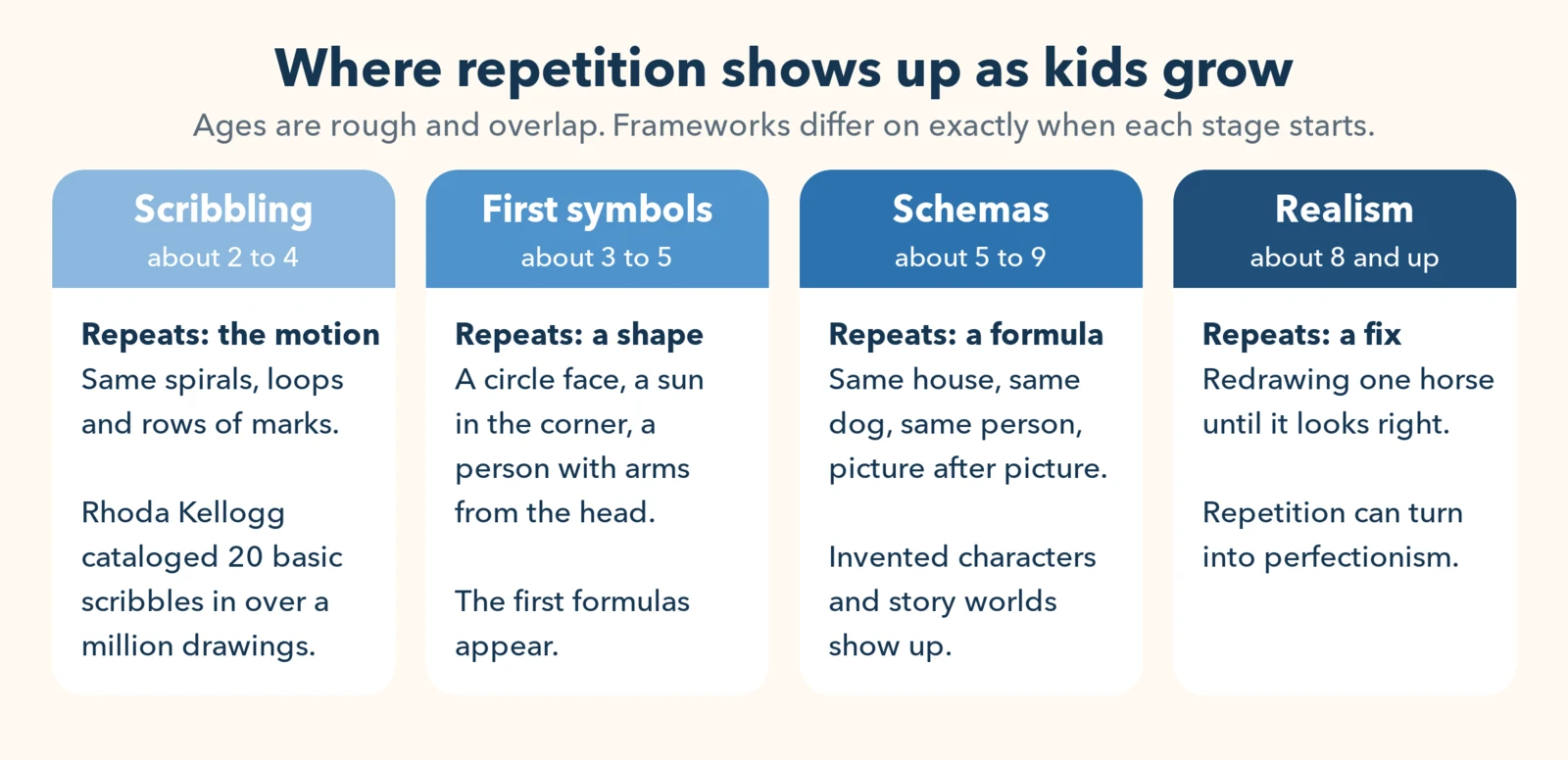
Children's drawing develops in stages, and repetition is built into the middle of it. The art educator Viktor Lowenfeld called one of those stages the schematic stage. An early childhood course text on artistic development describes it as the point where "we see the development of a consistent schema," with children representing "houses, trees, and people in a stable, repeated way," and "drawing them in a similar manner across multiple images."
A schema is a child's personal formula for a thing. Their person always has the same round head. Their dog always has the same four stick legs. Once a child has a formula that works, they use it, the way an adult who has finally nailed a recipe keeps cooking it. Lowenfeld placed the schematic stage at roughly seven to nine, other frameworks start it earlier, and plenty of five-year-olds already have a house they draw the same way every time. Kids' drawing development stages covers the whole sequence, and the point for a parent is that settling on a repeated form is a milestone, not a stall.
It starts even earlier than that. Rhoda Kellogg, a psychologist and nursery school teacher who studied over a million children's drawings, cataloged 20 basic scribbles that young children make again and again. The same course text puts it plainly: "These marks reflect motor control, repetition, and joy in movement."
Three reasons kids draw the same thing
There are usually three things going on, and most children are doing more than one at once.
Practice. A child who has found a way to draw a dragon has found something precious, a shape that works. Each new version is a chance to fix the thing that bothered them last time: the wing that came out too small, the tail that ran off the page. To an adult, forty dragons look identical. To the child, each one is a small correction.
Predictability. Small children live in a world where almost everything is decided for them: when to eat, where to go, when to stop. A page is one of the few places where the result is entirely theirs, and drawing the familiar thing guarantees it comes out right. Rebecca Parlakian, an early childhood expert at ZERO TO THREE, told NPR that "repetition is a really critical component to early learning," and that "there's something so nurturing when you can anticipate exactly what will happen in a routine or in a story." The same pull that makes a four-year-old want the same bedtime book every night makes them want the same dragon.
Love. Sometimes there is nothing deeper going on. A child who adores cats draws cats. A child obsessed with trains draws trains. Adults do this too. We just call it a hobby and nobody asks us to try something new.
What it looks like at each age
Ages 2 to 4. Repetition is mostly about the motion. The same spiral, the same row of circles, the same scribble pressed hard into the paper. There is nothing to decode. The child is enjoying what their arm can do and doing it again.
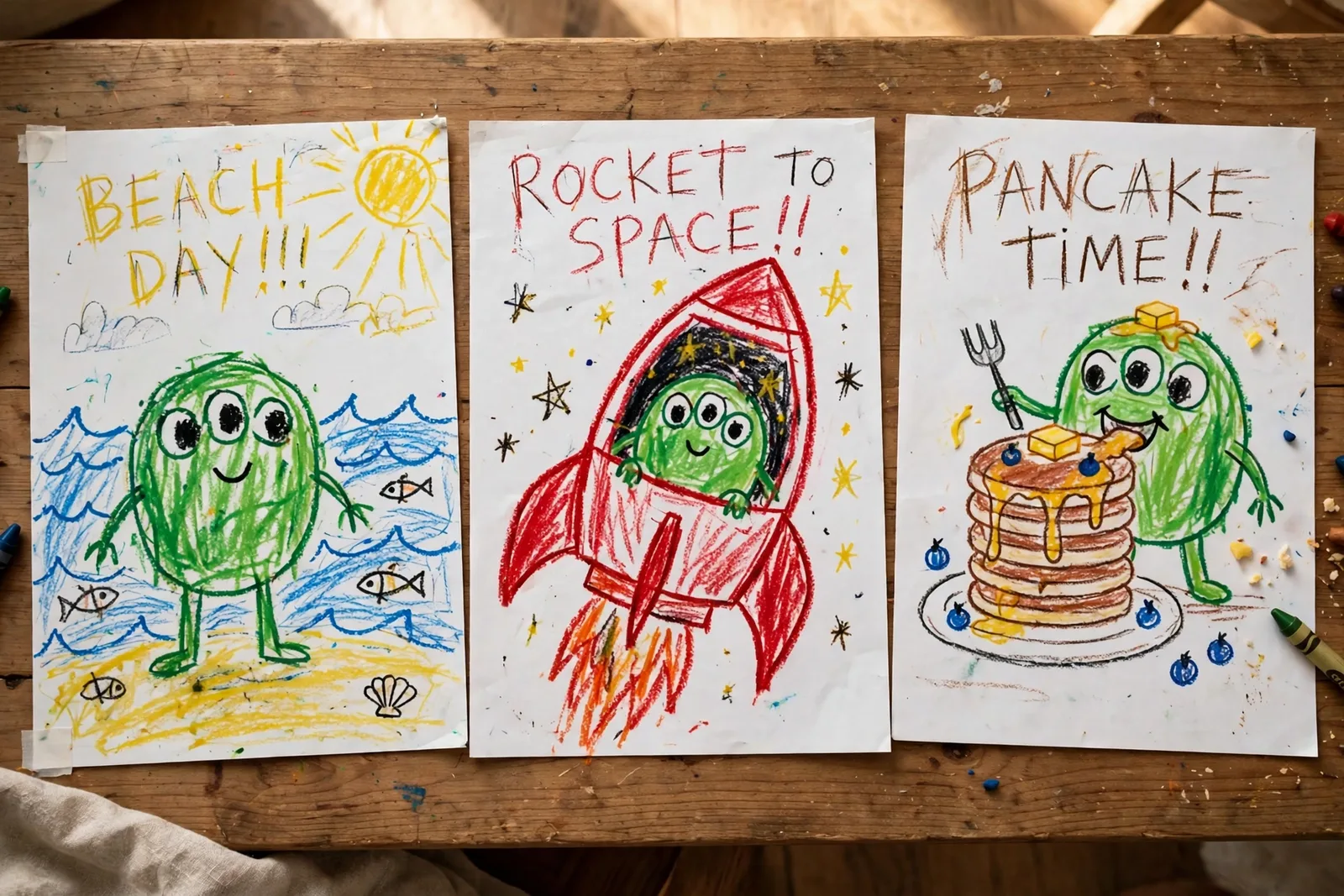
Ages 5 to 6. The repeated thing becomes a character. This is the child who invents a green creature with three eyes and then draws it at the beach, in a rocket, and eating pancakes. That is not a rut. The subject is fixed, and everything around it changes.
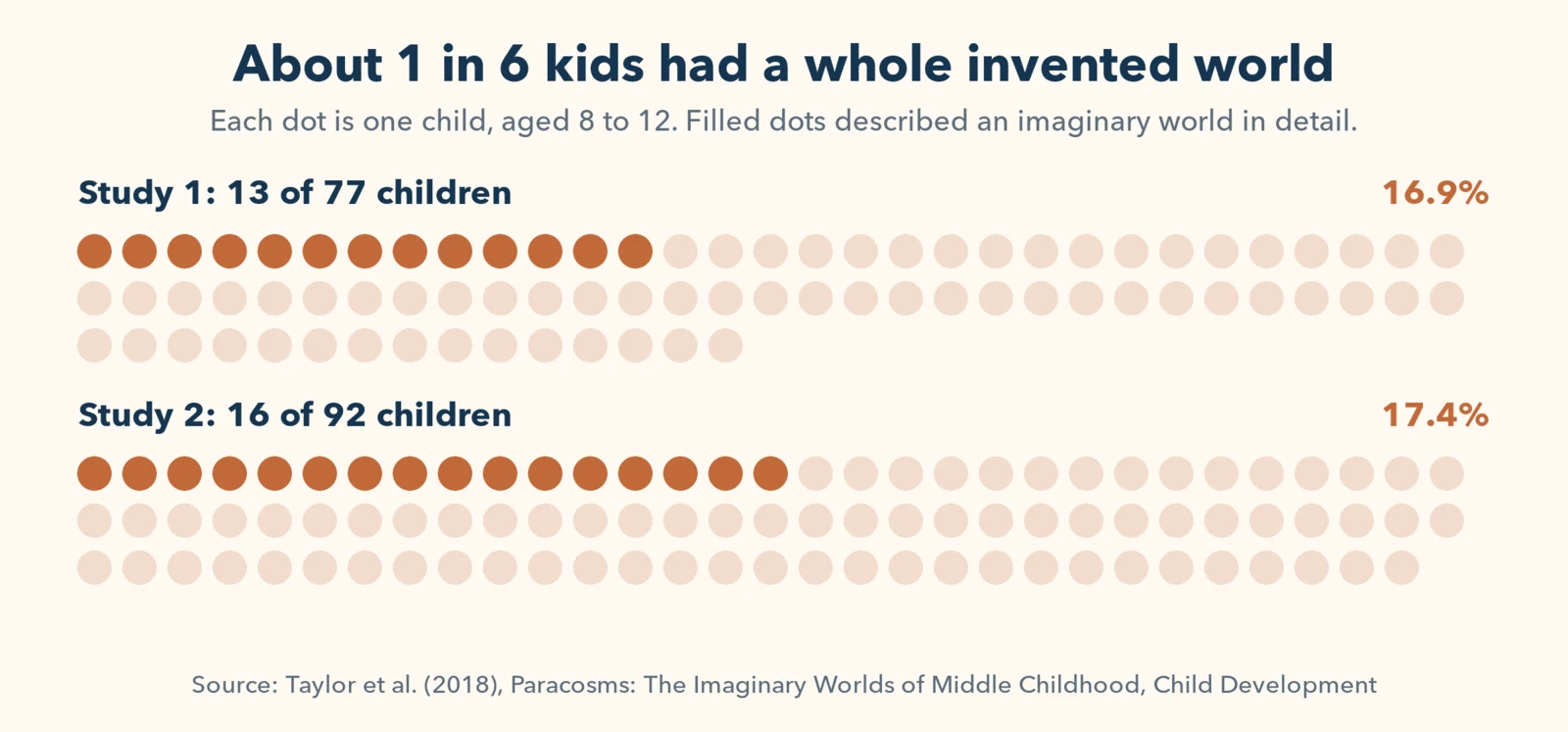
Some children take this a long way and build entire invented worlds, which psychologists call paracosms. In two University of Oregon studies of children aged 8 to 12, about 17 percent in each described an imaginary world in detail. The lead researcher, Marjorie Taylor, said the finding was reassuring: "It's a positive thing associated with creativity and storytelling, and it's not particularly rare." In the mid-1970s, Penn State art education professors Brent and Marjorie Wilson studied young people who drew for hours nearly every day. Most were drawing ongoing stories, often with characters borrowed from comics, at a time when art teachers believed that kind of borrowing destroyed creativity. The Wilsons argued it didn't.
Ages 7 to 8. Repetition can start to come from perfectionism. A child who restarts the same horse five times is chasing a version that matches the one in their head, and is getting frustrated that their hand can't deliver it. That is a different situation with a different answer, and what to say when a kid decides they're bad at drawing covers it.
Choosing to repeat is not the same as being told to
One study complicates the idea that more repetition is always better. The developmental psychologist Christiane Lange-Küttner at London Metropolitan University had 80 children aged 6 to 12 draw a person three times in a row, scored as part of a standard drawing test. Scores rose slightly on the second try, peaking at an average of 107, then fell to 96 by the last one. The press release headline put it bluntly: practice doesn't make perfect for kids. Giving children something new to draw, a police officer, temporarily brought the scores back up.
The study didn't compare chosen and assigned drawings, so this part is my reading rather than its finding: the difference seems to be who decides. A child redrawing a dragon because they want to is chasing something. A child redrawing a person because an adult asked them to is mostly complying. And the one thing that helped in the study, a new subject, is the same move that works at home. That is worth remembering if you are ever tempted to say "draw it again, but neater." The repetition that helps is the kind the child starts.
Follow the subject, or steer away from it
You have two options when the twentieth dragon arrives. You can nudge your child toward variety, or you can follow their lead.
Nudging ("Why don't you draw a flower this time?") tends to land as a verdict that the dragon isn't good enough. Most children hear it that way even when you don't mean it. Following sounds like curiosity: "Tell me about this one. What is she doing today?" Questions pull the story out, and the story is where the growth is.
If you do want variety, change the situation, not the subject. Where is the dragon going? What is she scared of? Who is her best friend? A bigger sheet, a darker pen, or a new problem for the character to solve will get you a completely different drawing without asking the child to drop the thing they love. A six-year-old will draw the same dragon underwater, at a birthday party, and lost in a supermarket if you ask where she has gone, and each of those is new territory. How to encourage kids to draw more has more on keeping the habit going without turning it into homework.
When to look a little closer
Repetition by itself is not a red flag. The question is never "how many dragons?" but "what does the rest of the day look like?" The CDC lists restricted or repetitive behaviors that can be associated with autism, and they are about rigidity across a child's life, not about a favorite drawing. They include a child who "lines up toys or other objects and gets upset when order is changed," who "gets upset by minor changes," or who "must follow certain routines." The CDC also notes that children with autism "may not have all or any of the behaviors listed."
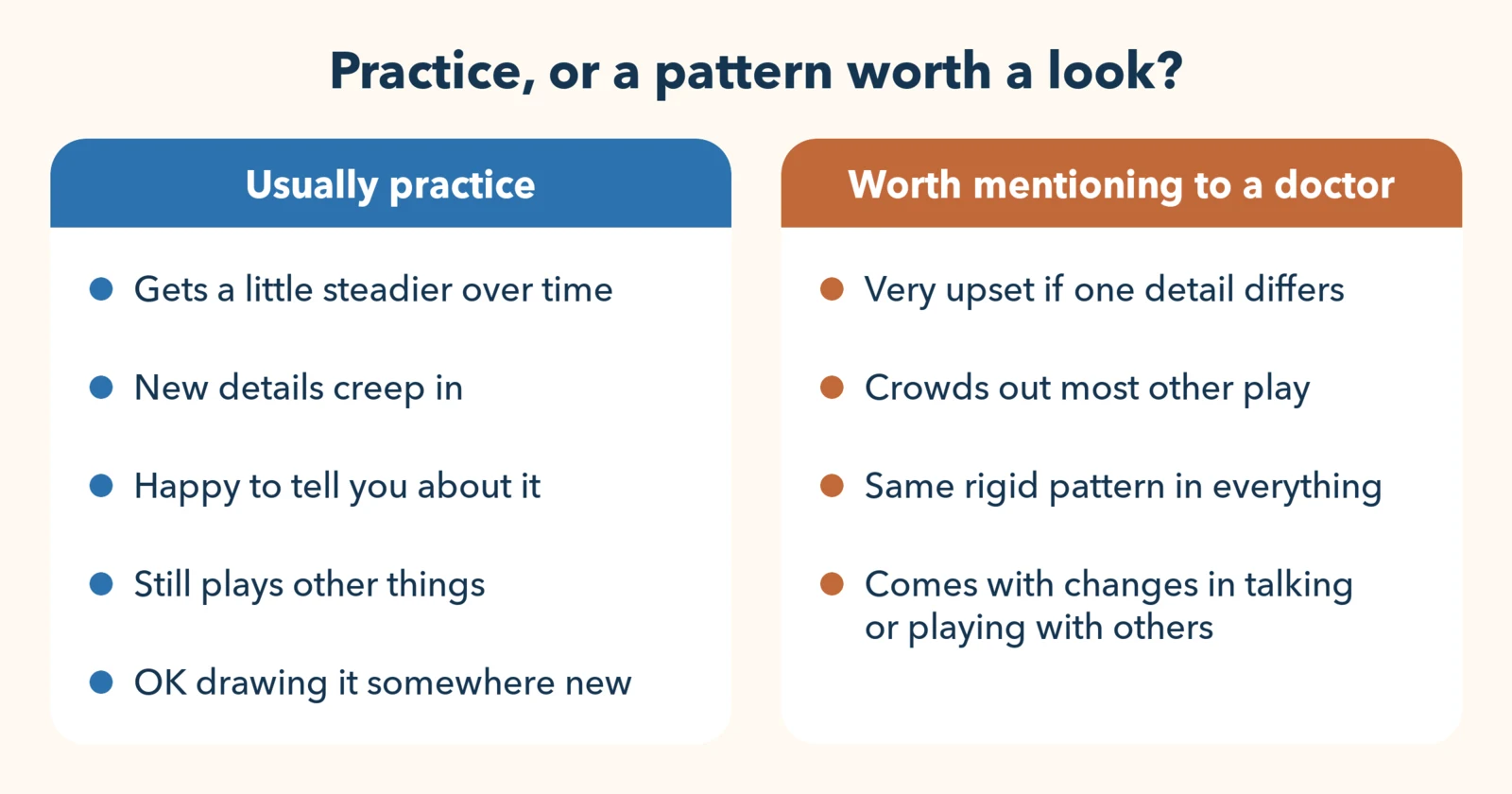
Put simply, a child who draws dragons all week and also plays with friends, tries new foods sometimes, and copes when the plan changes has a favorite subject. A child who becomes very distressed when one detail of the drawing is different, whose repetition shows up across everything from getting dressed to playing, and who has other differences in talking or play, is worth a conversation with your pediatrician. That conversation is about the child, not the drawing.
What to keep from forty dragons
The forty dragons are worth more together than any one of them, but only if you don't keep all forty. Save the first one, the best one, and one from roughly every month in between. Date the back. Line them up a year from now and you can watch your child's hand get steadier in real time, which a box of near-copies will never show you.
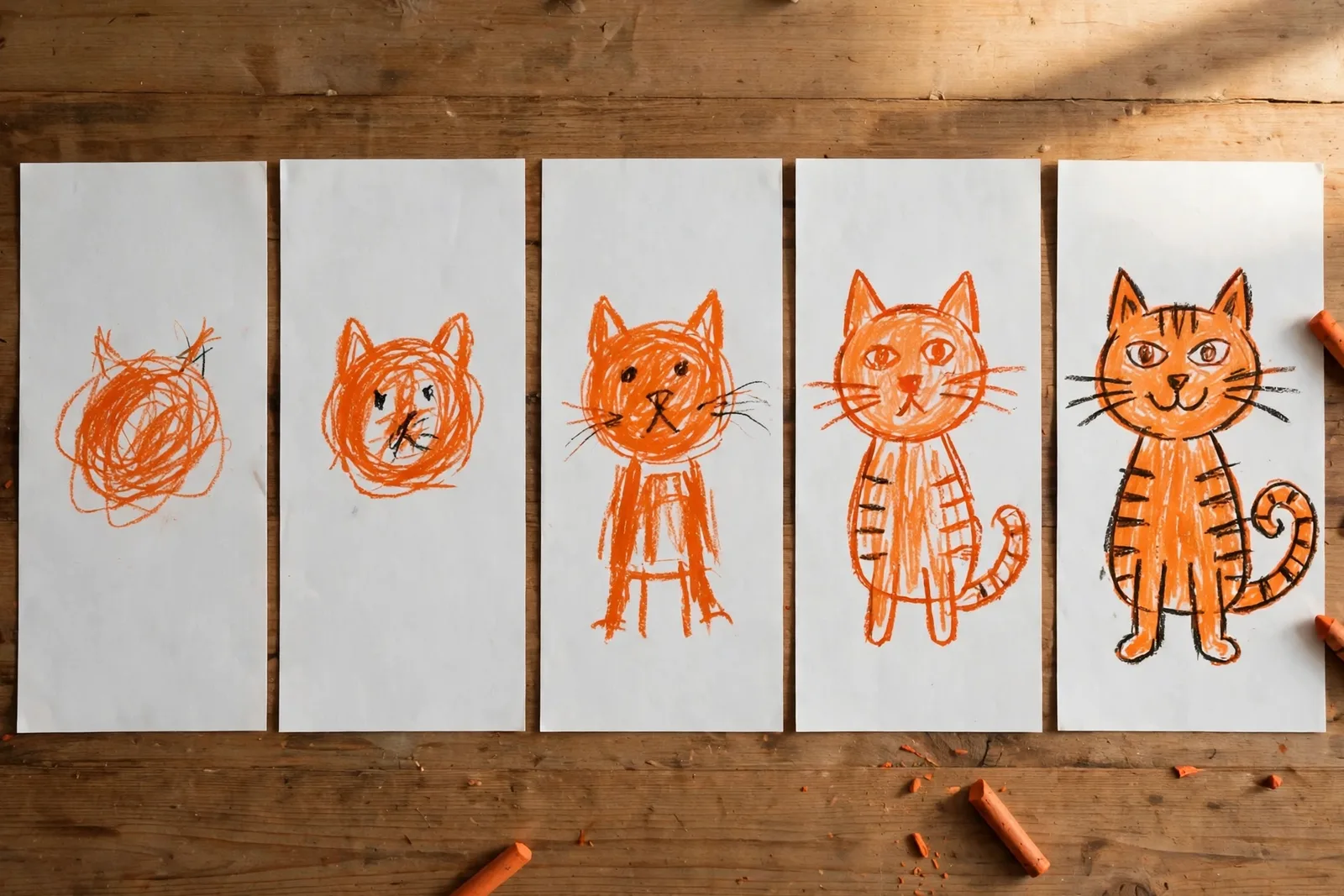
The character itself is the real keepsake. A dragon that has lived on every page of a sketchbook for a year already has a personality, a favorite food and a list of places she has been. The thing she is missing is a story. DoodleTale turns one drawing into a printed storybook with the drawn character as the hero, and a recurring character is a natural fit, because your child already knows exactly who she is. Pick the version your child likes best, not the one that looks most finished.
Yes. Repetition is one of the main ways young children get better at drawing. A child who draws the same dragon every day is usually refining a shape they care about, enjoying something predictable, or building a character. On its own, repetition is not a warning sign.
Around five, many children settle on a few reliable symbols they can draw with confidence, and invented characters start to appear. If your child draws the same character in different places and situations, that is a growing imagination at work, not a limit on it.
Not by itself. Look at the rest of the day instead. If your child also plays with others, tries new things, and copes when routines change, the drawing habit is healthy. If the repetition replaces most other play or comes with real distress over small changes, mention it to your pediatrician.
Change the situation, not the subject. Ask where the favorite character is going today, offer a bigger sheet or a new kind of pen, or suggest a problem for the character to solve. Asking a child to drop the subject they love usually lands as a verdict on it.
No. Keep the first one, the best one, and one from roughly every month in between. Lined up in order, those few show the progress more clearly than a box of forty near-copies, and they take up a folder instead of a closet.
Save the first dragon. It is the one that shows how far the fortieth came.
Try it yourself
Turn your child's drawing into a real storybook
Free preview. No account needed. Ships to US & Canada.