Kids' drawing development stages: what changes at each age
Kids' drawing development stages: what changes at each age
Children move through four drawing stages, from scribbles to detailed scenes. Here's what each kids' drawing development stage looks like, when it ends, and why keeping one from each matters.
Children move through four predictable drawing stages: scribbling (about 18 months to 4), pre-schematic first symbols like the tadpole person (3 to 5), the schematic stage with ground lines and repeated shapes (5 to 7), and dawning realism with self-criticism (7 to 9). Each stage lasts a year or two, then it's gone. Most parents only notice a stage after it has already passed, which is why keeping one drawing from each is worth doing while it's happening.
Your three-year-old's chaotic spiral isn't random. Your four-year-old's person with legs growing straight out of the head isn't a mistake. These are recognizable milestones in kids' drawing development, and they're happening on your fridge right now, one drawing at a time.
Art educators have been mapping these stages for over a century. The four-stage version most teachers still use comes from Viktor Lowenfeld, and while every child moves through it at their own pace, the sequence itself is remarkably consistent. Here's what each stage looks like, roughly when it ends, and why it's worth holding onto a piece of each one.
Stage 1: Scribbling (ages 2–4)
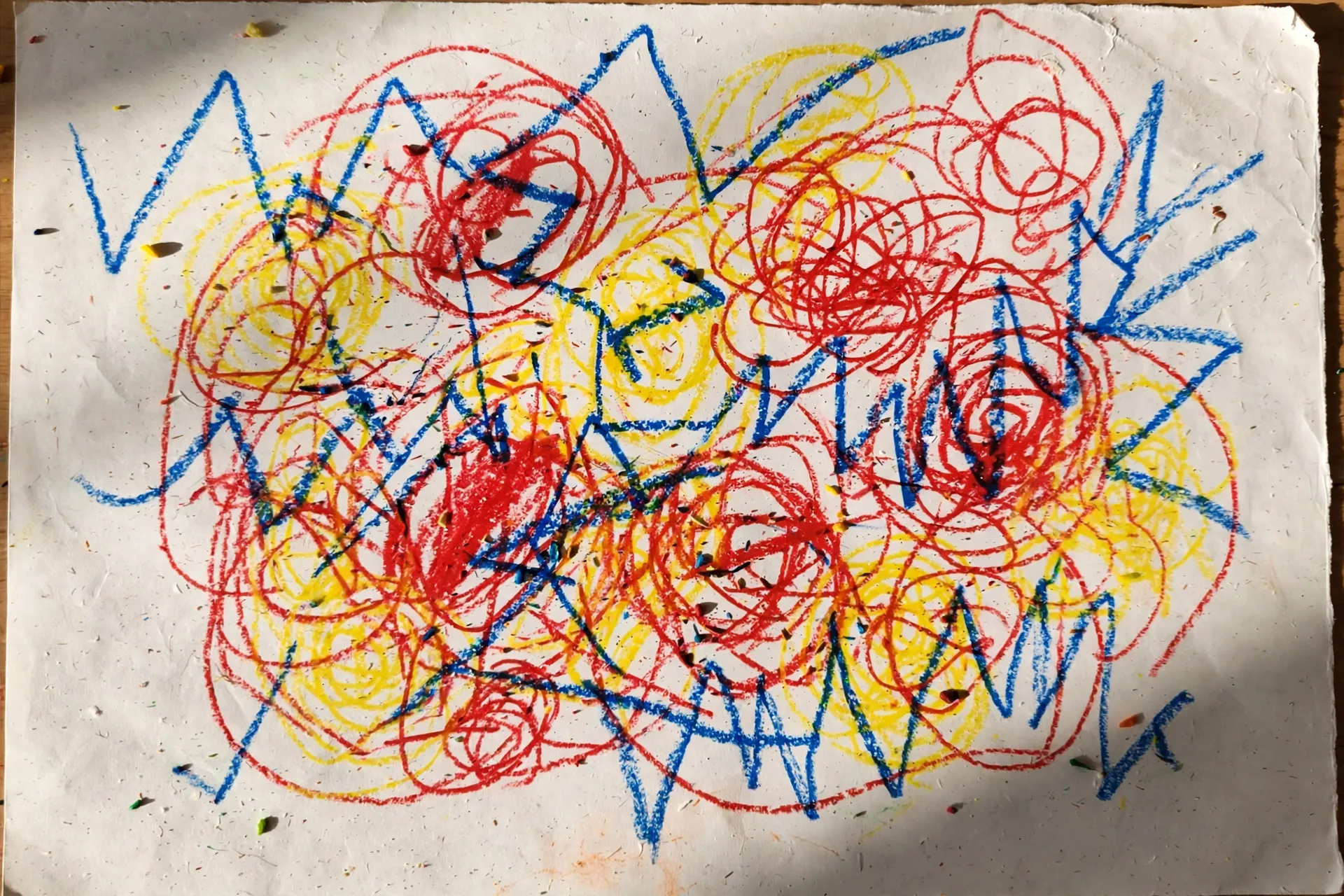
Early scribbling isn't meaningless mark-making. Around 18 months, children discover that their own movement leaves marks, and the physical feedback is the entire point. They're not trying to draw anything. They're finding out what a crayon does. The motion is the goal.
By age three, scribbles turn intentional. Your child starts repeating the same mark on purpose: a spiral they can control, a zig-zag, a circle they can finally close. Researcher Rhoda Kellogg, who spent decades studying children's art, cataloged around 20 basic scribble types that show up across cultures before a child can explain what they made. These marks aren't pre-drawing noise. They're the visual alphabet children build before real pictures arrive.
Stage 2: Pre-schematic and first symbols (ages 3–5)
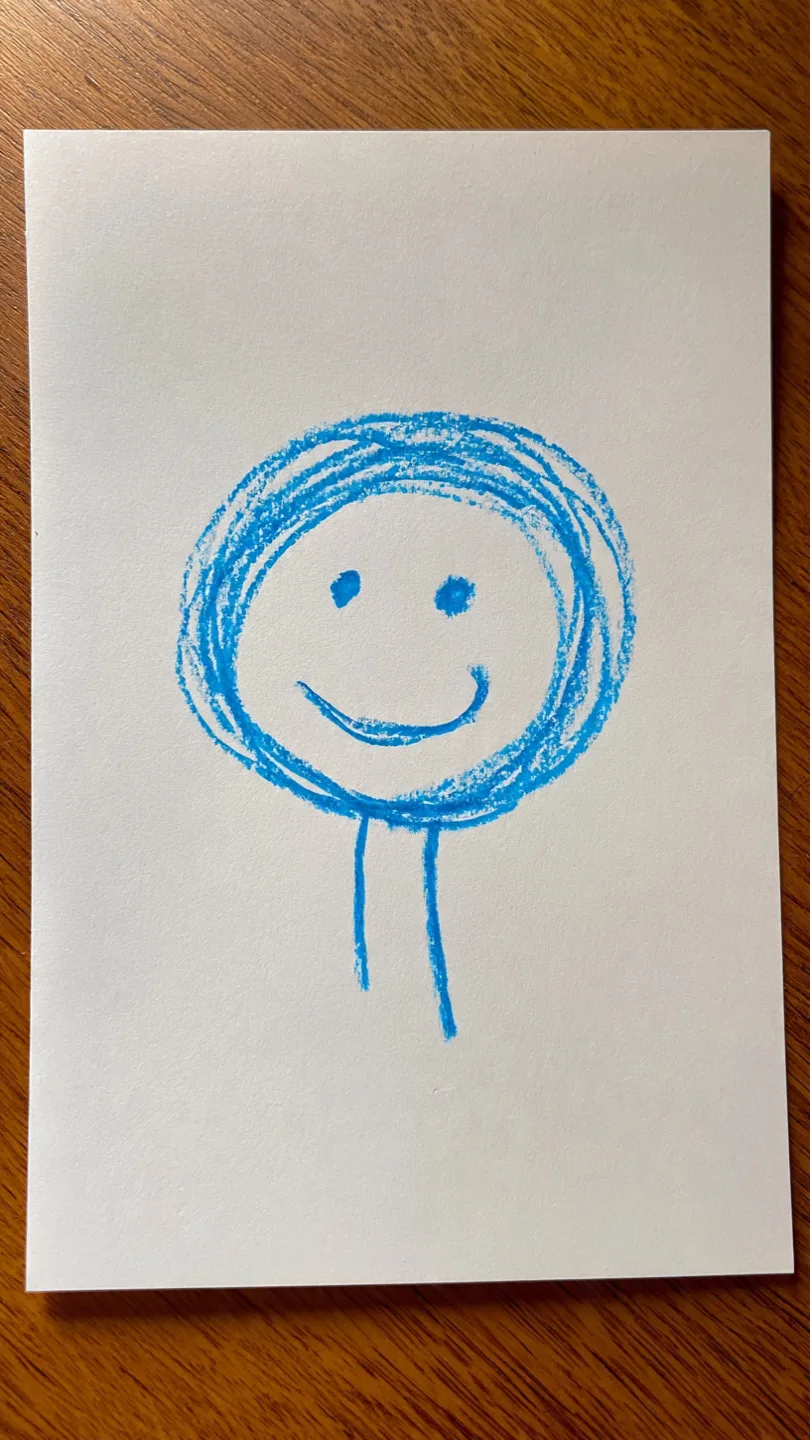
This is when parents first recognize something, and it's almost always a person. The classic is the "tadpole figure": a circle with legs attached directly, no body in between. This isn't a motor-skill failure. It's how four-year-olds genuinely think a person is put together. The face matters most, the legs do the moving, and a torso feels unnecessary for another year or two.
In this phase children also park a sun in every corner regardless of the scene, float objects with no ground underneath them, and grow arms straight out of heads. Zero to Three, one of the leading early-childhood organizations, describes these "pre-schematic" markers as healthy developmental signs, not errors to correct, but a window into how young children actually see the world.
Stage 3: Schemas and symbol systems (ages 5–7)
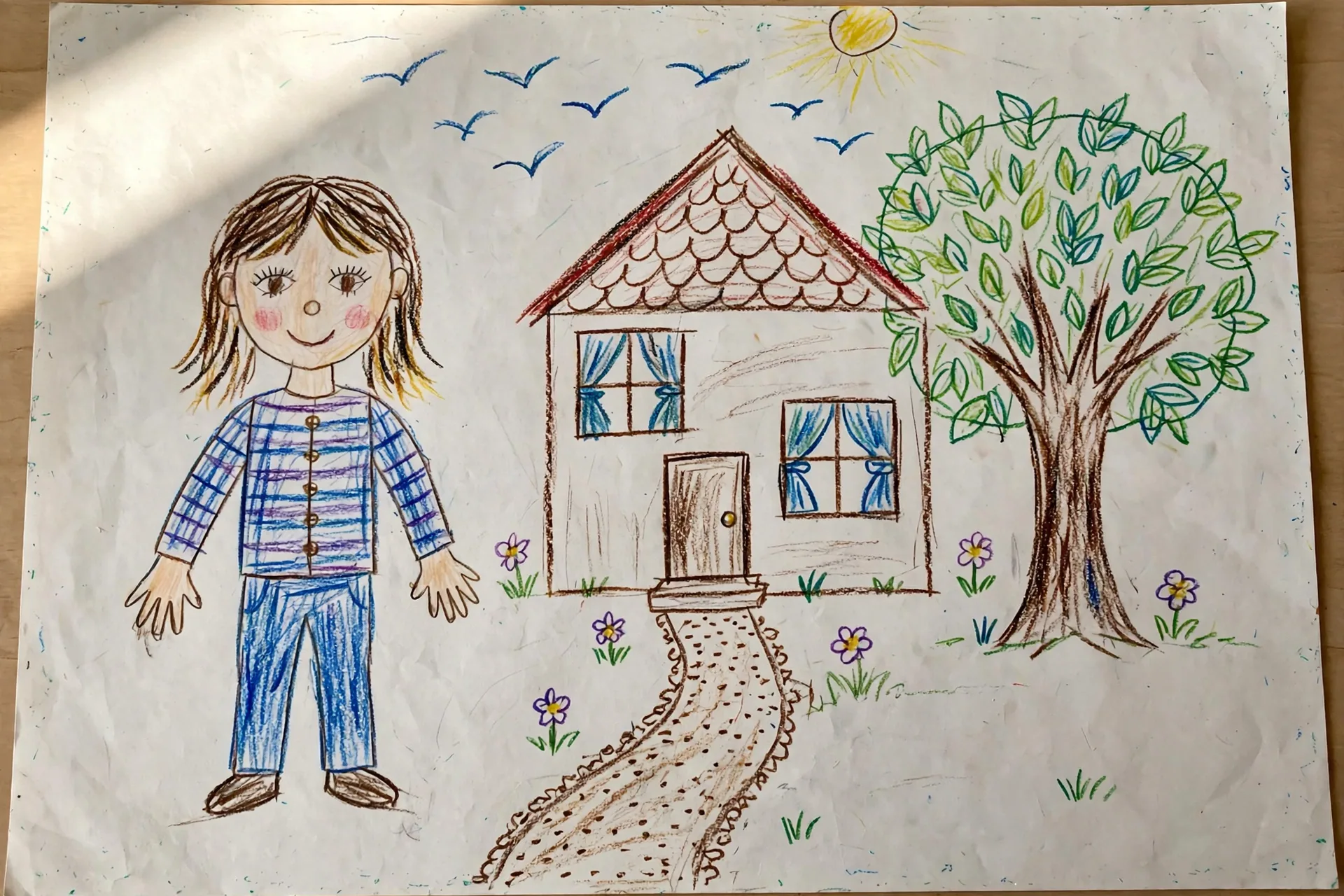
Around age five, drawings gain a ground line, a base that everything sits on, and a strip of sky at the top. Objects settle into consistent "schemas": your child's person looks the same each time, their house has a shape they've decided on, their dog follows a formula they repeat. These personal symbol systems are a sign of growing cognitive sophistication, not a limitation.
This is the drawing phase most adults remember making: colorful scenes with stick figures, a house, a family, a sun with rays in the corner. A 2024 study in Nature Communications, from a Stanford-led team that analyzed roughly 37,000 children's drawings, found that drawings become steadily more detailed and more recognizable at each age in consistent, predictable ways. What your child draws this year is, broadly, what children draw at this age. It isn't just your kid. It's the age.
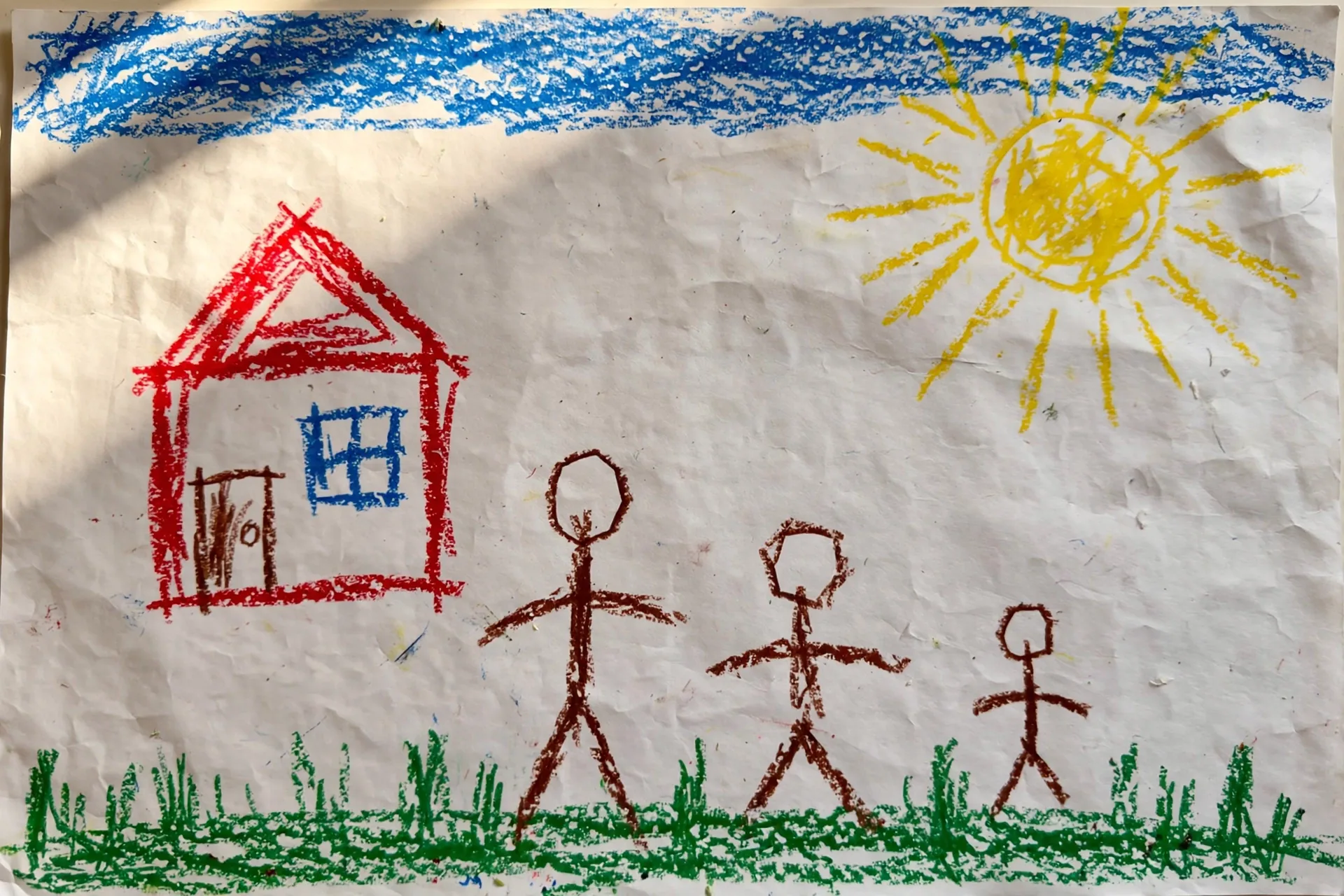
The schema window runs about ages five to seven. It's shorter than it feels while you're in it.
Stage 4: Dawning realism and the critical turn (ages 7–9)
Around age seven or eight, something shifts. Children start noticing the gap between what they picture and what their hand can actually produce. They compare their drawings to other kids' and to realistic art, and they get more critical. Plenty of children who drew all day at five announce at eight or nine that they "can't draw," and stop almost entirely.
This is exactly when earlier drawings become most precious, because the child is already starting to view their own past art as evidence of a younger self rather than something to be proud of. A book made from a tadpole-figure drawing at four becomes, at nine, a genuine artifact from a different chapter. They will never make marks quite like that again. If you want a fuller read on what the drawings themselves are saying while they're happening, what your child's drawings are really telling you goes deeper on the meaning behind them.
Two ways to keep each stage, and the difference between them
Photographing drawings works as a first step, but the images tend to vanish into a camera roll nobody scrolls back through. The drawings that actually get honored are the ones given a form that matches their weight. How to preserve kids' artwork walks through the methods that genuinely last, from framing to digitizing.
One option worth knowing about is turning a single drawing into a book. DoodleTale takes one drawing and builds a printed storybook around it, which means the wobbly tadpole from age four, the busy schema scene from age six, and the more careful drawing from age eight can each become something physical and permanent. Parents who've ordered across a few ages describe holding the books side by side and seeing exactly how much changed, a kind of record a folder of photos can't quite replicate.
You don't have to do every drawing. One per stage, saved when you notice your child has hit a new level of intention, is plenty. The pre-schematic drawings, the tadpole people and floating suns, are usually the ones you'll be most grateful you kept by the time they're ten.
Stages are easier to spot when a child draws often. If getting them to the paper is the harder half, how to encourage kids to draw more covers that without turning it into a chore, and things for kids to draw when they're bored is the prompt bank for when they are willing but stuck.
Frequently asked questions
The drawing on your fridge this week is already a relic. Your child won't make marks quite like this again, so keep the one that shows where they are right now.
Try it yourself
Turn your child's drawing into a real storybook
Free preview. No account needed. Ships to US & Canada.
Start for free