"I'm bad at drawing": what to say when your kid starts tearing up their own art
"I'm bad at drawing": what to say when your kid starts tearing up their own art
The moment a child decides they are bad at drawing is usually a sign their eye has outrun their hand. What to say, what not to say, and why praise is the wrong tool.
Stop rating the drawing and start describing it. Most children announce they are bad at drawing around age eight or nine, when their eye starts judging realism and their hand cannot deliver it yet. The drawing did not get worse. The standard changed. Reassurance fails because the child can see the gap you are denying, so describe what is on the paper instead, keep the paper cheap and plentiful, and give the drawings a destination other than the fridge.
There is a specific afternoon most parents remember. A child who has drawn every day for four years looks at what they just made, says "it's bad," and puts it in the bin. Sometimes they tear it first. Then they say they don't want to draw anymore, and for a while they mean it.
It reads like a confidence collapse, and the instinct is to treat it as one. Tell them it's good. Put it on the fridge. Say you love it. That instinct is understandable and it almost never works, because the child is not asking for a second opinion. They have just acquired the ability to see something they could not see last year, and your reassurance asks them to un-see it.
This is a different problem from a child who has simply stopped drawing. If your child hasn't decided they're bad at it and has just drifted away from the table, how to encourage kids to draw more is the one to read. This post is about the child who is still interested and has started grading themselves.
The eye outruns the hand
Children's drawing does not improve in a straight line. It improves, then it appears to collapse, then it improves again. Howard Gardner described this as a U-curve: work in the preschool years that adults find genuinely charming, followed by a middle-childhood trough where the drawings become stiffer and more literal, followed by recovery for the minority who keep going.
The trough is not a loss of skill. It is the arrival of a new standard. Somewhere around eight or nine, most children stop drawing what they know about a horse and start trying to draw what a horse looks like. The first project is achievable for a five year old. The second is difficult for an adult.
Ellen Winner, who has spent a career on children's artistic development at Boston College, makes the point that the young child's freedom is partly ignorance of the rules. Once a child can see perspective, proportion and foreshortening, they can also see themselves failing at all three. The drawing that would have delighted them at six now sits there with every error visible.
One caveat worth keeping, since this idea gets repeated as settled fact: the U-curve is a Western finding, and cross-cultural work has challenged how universal it is. Judges from other traditions do not necessarily rate young children's drawings the way Western judges do, which suggests part of the curve describes adult taste rather than the child's development. The middle-childhood shift toward literal, realistic drawing is well documented. Whether the dip is a real loss or a change in what adults happen to admire is less settled than it sounds.
So when a child says "it's bad," they are frequently right, by the standard they have just adopted. That is why "no it isn't" bounces off. You are arguing against something they can see and you are asking them to trust your eye over their own, which is a bad trade for them.
Describe it, don't rate it
The replacement for praise is not criticism. It is description.
Rating a drawing, in either direction, keeps the child's attention on the verdict. Describing it moves their attention back to the paper. The difference sounds small and does not feel small to a child who has just decided they are failing.
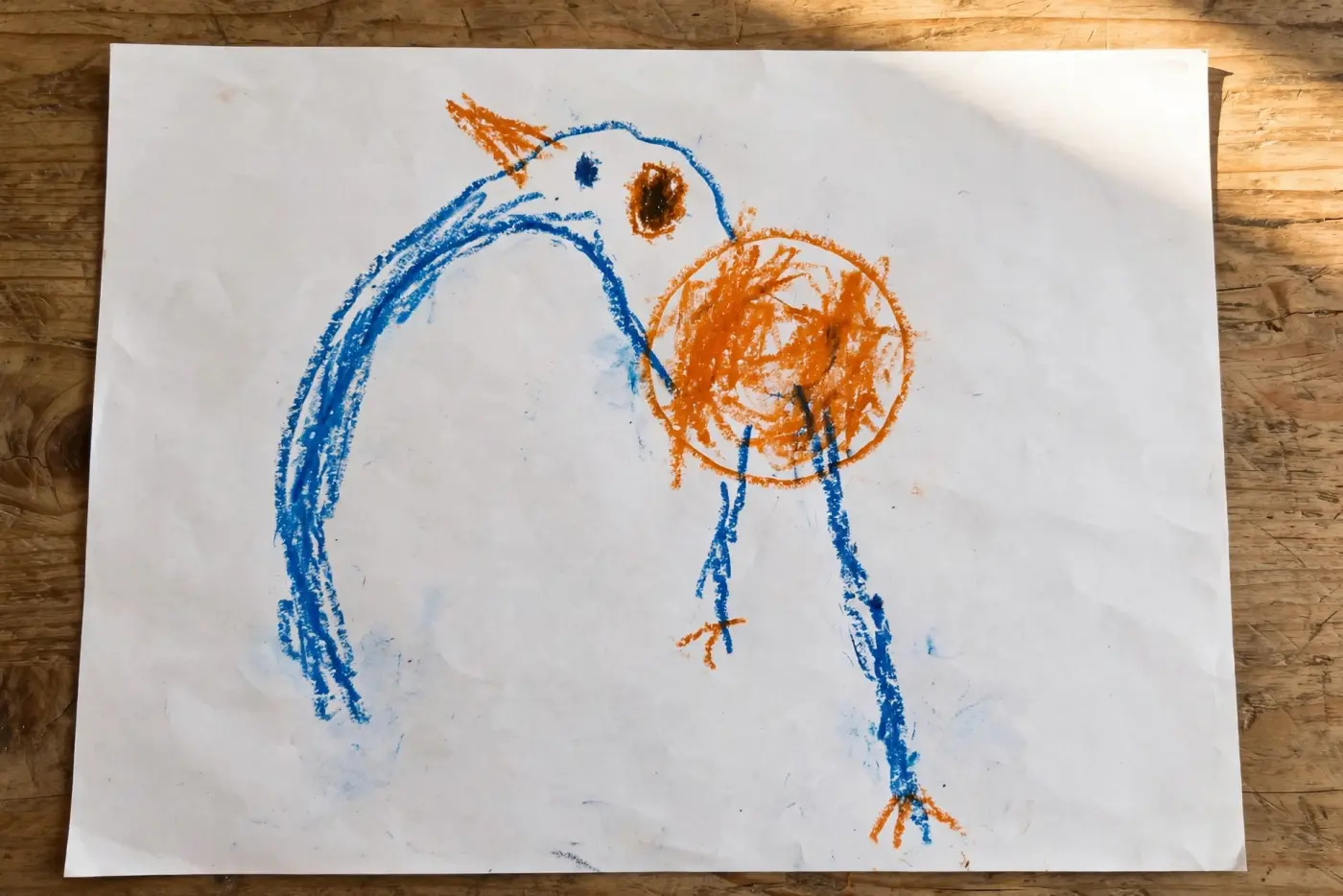
Instead of "that's great," try naming what is actually there. The dog is running, and you can tell because of the legs. Everything in this one is orange except the door. You spent a long time on the roof. This one is much darker than the ones you usually make.
None of those are compliments, which is the point. They are evidence that someone looked. A child who has just declared their work bad is usually braced for either a lie or a correction, and a plain observation is neither. It also gives them a foothold: a child told "the dog is running and you can tell because of the legs" now knows one thing that worked, which is more actionable than being told the whole thing is good.
This is the same reason the National Association for the Education of Young Children keeps pushing process over product in early art. The relevant question is what happened while the child was making it, not what score the artifact earns afterward.
Stop asking them to try their best
A surprising amount of drawing paralysis comes from the paper itself.
If drawing happens on good paper, one sheet at a time, and every finished sheet gets kept or displayed, then every sheet is an exam. A child who believes a drawing is an exam will avoid starting one, and the avoidance looks like "I'm bad at this" because that is the available vocabulary.
The fix is unglamorous. Cheap paper, a lot of it, within reach, with no expectation that anything gets kept. Printer paper, the back of junk mail, a roll of it. The message a full stack of cheap paper sends is that a drawing costs nothing and there are plenty more, which is the only condition under which a perfectionist child will risk a first line.
A useful test: watch what happens when your child ruins a drawing halfway through. If they can abandon it and start another without ceremony, the stakes are set correctly. If ruining one produces a crisis, the paper is too precious, and the fastest intervention is more paper rather than more encouragement.
Harvard's Project Zero, in the Studio Thinking work on what art classrooms actually teach, lists "engage and persist" as a distinct habit that has to be learned rather than assumed. Persistence is not a personality trait the child either has or lacks. It is a thing that becomes possible when the cost of a failed attempt is low enough.
What not to say
A few well-meant lines make it worse, reliably.
"You're so talented" raises the stakes rather than lowering them. Talent is fixed by definition, so a child who accepts the label now has something to lose on every drawing, and the safest way to protect a reputation for talent is to stop producing evidence.
"It's beautiful, I love it" is heard as a non-answer when the child has just pointed at a specific failure. They said the legs are wrong. A response that does not engage with the legs tells them the conversation is not real.
"Everyone's art is good in their own way" concedes the argument. It accepts that the drawing is bad and offers a consolation category.
And "you just need to practice more" is true and useless in the same breath, because the child is not in a state to hear a long-term plan. That one keeps for a calmer day.
The line that does tend to work is smaller than all of these: "what were you trying to get?" It treats the child as someone with an intention rather than someone with a feeling to be managed, and the answer is usually specific. The legs. The face. Making it look like it's moving. Once you know the actual target, you can help with the actual target, and a child who gets help with legs finds out that the problem was legs rather than themselves.
What we learned by refusing to fix the drawings
We build personalized storybooks at DoodleTale, and the whole product rests on one decision we made early and have had to defend repeatedly: the child's drawing does not get corrected.
When a child's drawing comes into our pipeline, the obvious thing to do with it, technically, is clean it up. Straighten the wobble. Even out the proportions. Make the eyes match. Every one of those is easy now, and the first versions we tried did some of it, because the output looked more competent.
It was worse. Not slightly worse, categorically worse. A cleaned-up drawing stops being the child's drawing and becomes a generic illustration that happens to resemble it. The parents could tell instantly. More importantly the children could tell, and the reaction we were building the whole thing for simply did not happen.
What produces the reaction is the opposite. The lopsided eye stays lopsided. If the legs are different lengths, the character has legs of different lengths on all thirty pages, consistently, as though that were simply true about them. The illustration style around it changes, so it sits inside a real book, but the specific wrongness that makes it that child's drawing and nobody else's is preserved on purpose.
The thing worth reporting here is what children do when they see it. The child who thought the eye was a mistake sees the mistake treated as a design decision by something that clearly had the option to change it. We did not set out to build a confidence intervention and it would be overreaching to call it one. But the mechanism is not mysterious: every adult response to a flawed drawing is either praise or correction, and this is neither. It is the flaw, kept, at size, in print.
Give the drawings somewhere to go that isn't the fridge
The fridge has a problem: it is a display case, and a display case implies selection. Something goes up, which means something else did not, and a child who has started grading themselves will notice the sorting.
What helps more is a destination that does not sort. A box that everything goes in. A folder per year. A notebook that gets drawn in front to back, so the sequence is the point rather than the individual page. The child stops producing candidates for approval and goes back to producing pages.
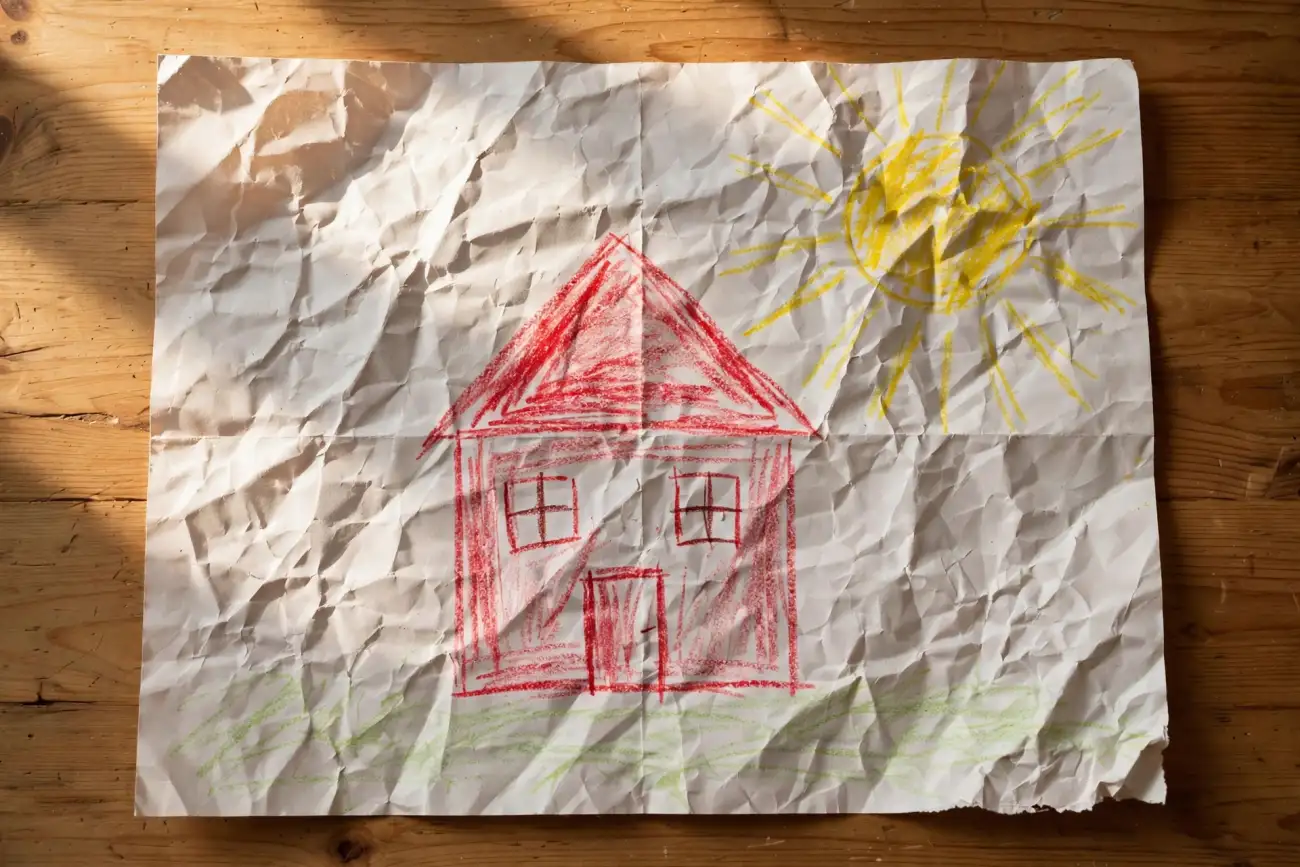
A step beyond that is giving the drawing a job. A drawing that becomes a birthday card is doing something. A drawing that becomes the label on a jar, or a poster for a made-up event, or the character in a story, has a function that is not "be good enough to display."
This is the mechanism behind our own product, and it is worth being plain about how it works. A DoodleTale book takes one drawing your child made and builds a 30-page illustrated storybook around it. The creature they invented becomes the character, kept in their own proportions, and your child is credited as the author on a book that has their name on it. The character arrives in about a minute and the full preview is free, so you can see exactly what happened to the drawing before deciding anything. A printed 8×8 inch premium softcover is $29.99 with free shipping in the US and Canada, and the digital version is $9.99. There is also a free printable Activity Kit, a coloring page or paper doll made from their own character, which is the lowest-stakes version of the same idea.
For the specific child this post is about, the relevant part is not the book. It is that the drawing was used rather than judged, and that nobody asked whether it was good first.
When to actually worry
Most of this is developmental and passes. A few patterns are worth more attention.
If the self-criticism is not confined to drawing, drawing is not the subject. A child who says they are bad at drawing, bad at reading, bad at soccer and bad at making friends is describing a general belief about themselves, and the drawing is just the day's example.
If a child destroys work compulsively rather than in frustration, or cannot tolerate any error on any page, or avoids starting anything with a possible wrong answer, that is worth raising with your pediatrician. Perfectionism at that level is treatable and does not tend to resolve by itself.
And if a child quits drawing entirely and stays quit for months while everything else is fine, that is often just a genuine change of interest. Not every abandoned hobby is a wound. Some children stop drawing at nine because they have discovered chess.
Where that leaves you
The child is not wrong about the gap, so do not argue about the gap. Describe what is on the paper. Make paper cheap and abundant so a failed drawing costs nothing. Ask what they were trying to get, then help with that specific thing. And find the drawings a use, because a drawing with a job does not have to be good.
Most children come out the other side of this, and a decent number of the ones who don't were not talked out of it by praise. They were kept in the habit by having somewhere for the drawings to go.
Frequently asked questions
If you want to understand what your child is actually making rather than how well they are making it, what kids' drawings reveal about them covers what shows up on the page, and kids' drawing development stages maps the ages this post's trough sits inside.
A drawing that has a job does not have to be good. That is most of the fix.
Try it yourself
Turn your child's drawing into a real storybook
Free preview. No account needed. Ships to US & Canada.
Start for free