The best gift for an older sibling when a new baby arrives
The best gift for an older sibling when a new baby arrives
The best gift for an older sibling when a new baby arrives is not a distraction toy. What pediatricians recommend, and the gift that lasts.
The new baby gets the nursery, the announcement, and the visitors. The older sibling usually gets a "big kid" t-shirt and a toy to keep them busy. Neither says the thing that child needs to hear. A storybook built from a drawing they made does, because it makes them the one who contributed rather than the one being managed. DoodleTale turns one drawing into a printed book, and you can see a free preview before deciding anything.
Every family hits the same question in the last month of a pregnancy: what do you give the older child when the new baby arrives? It comes from several directions at once. Parents want something for the big kid on homecoming day. Grandparents ask what to bring. Friends visiting in the first weeks feel the imbalance in the room, four gift bags for a newborn who cannot open any of them, and want to even it out.
Everyone senses the older child needs their own moment. Fewer people know what to put in it, so the default is a toy, and the toy is usually forgotten by the time the baby is sitting up.
Why this moment carries more weight than it looks
The arrival of a sibling reshapes a young child's world quietly rather than dramatically. Routines shift. The supply of undivided attention drops. The role they held in the family changes without anyone asking them.
The American Academy of Pediatrics breaks the reaction down by age, and the pattern is consistent. Preschoolers between 2 and 4 are still learning to share and may feel they have to compete for a parent's attention. Some regress, with a toilet-trained child suddenly having accidents, which the AAP describes as a normal way of checking that the love and attention are still there. Children over 5 are less threatened by the baby itself but often resent the attention it gets.
Two of the AAP's recommendations matter for the gift question specifically. The first is to involve the older child in planning for the baby, which they say makes the child less jealous. The second is to ask family and friends to spend time with the older child when they visit, noting that some will also bring a small gift for them alongside the baby's.
So the gift is not a bribe and not a consolation prize. Done well, it is the involvement itself, made into an object.
Distraction gifts and recognition gifts do different jobs
Almost everything given to an older sibling falls into one of two buckets.
A distraction gift occupies the child while the adults are absorbed with the baby. A new set of blocks, a sticker book, a toy that buys twenty minutes during a feed. There is nothing wrong with this. It solves a real logistical problem in week one, and any parent who has needed to redirect a 3-year-old at 4pm knows the value.
A recognition gift does something else. It acknowledges the older child's specific position in the new arrangement. Not "here is something while we're busy" but "we thought about you on purpose." That is the one still around a year later, because it was given to the child rather than to the problem.
Recognition gifts are harder to find, which is why most people default to distraction. The standard big sibling options are either generic, a "Big Brother" shirt that every older sibling in the country receives, or instructional, a picture book about learning to be a sibling. Both are kind. Neither is about this particular child.
Why a storybook built from their own drawing fits
The gift that solves recognition is one where the older child is the maker.
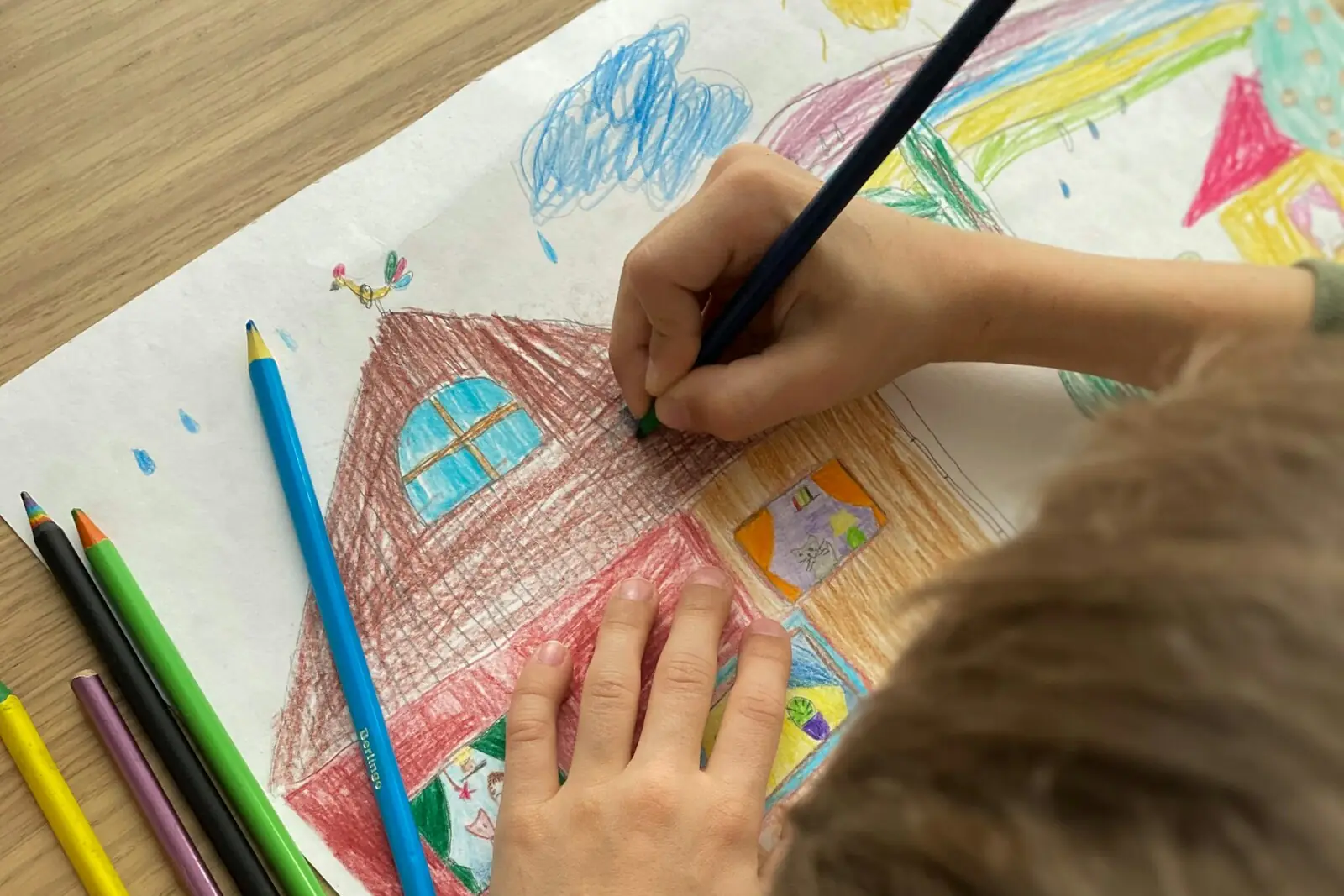
DoodleTale starts from a drawing the child actually made and builds a printed storybook around it. Their drawing becomes the illustrated character, carried through the whole book rather than tidied up or replaced. Their name is in the story. They are credited as the person the book came from.
For an older sibling that does two things a stuffed animal cannot.
It changes their position in the event. They are not waiting for the baby to stop being new. They made something for this family, before the baby even arrived, and here is the proof of it. That maps directly onto what the AAP recommends: involve them in the preparation, and the jealousy has less to grip onto.
It also gives them something that is about them, in a month when nearly everything is about someone else. Not a book about adjusting to a sibling. A book that came out of their own hands. The AAP frames the sibling bond itself as a foundation of a child's emotional well-being, which is worth remembering when the gift includes the baby rather than competing with them.
The difference is between being told and being shown. "We love you just as much" is true, and a 4-year-old cannot do anything with it. A book on the shelf with their crayon dinosaur on every page is evidence they can hold. There is research behind why this format holds a child's attention, covered in more depth in do personalized storybooks actually benefit children.
What the book actually is
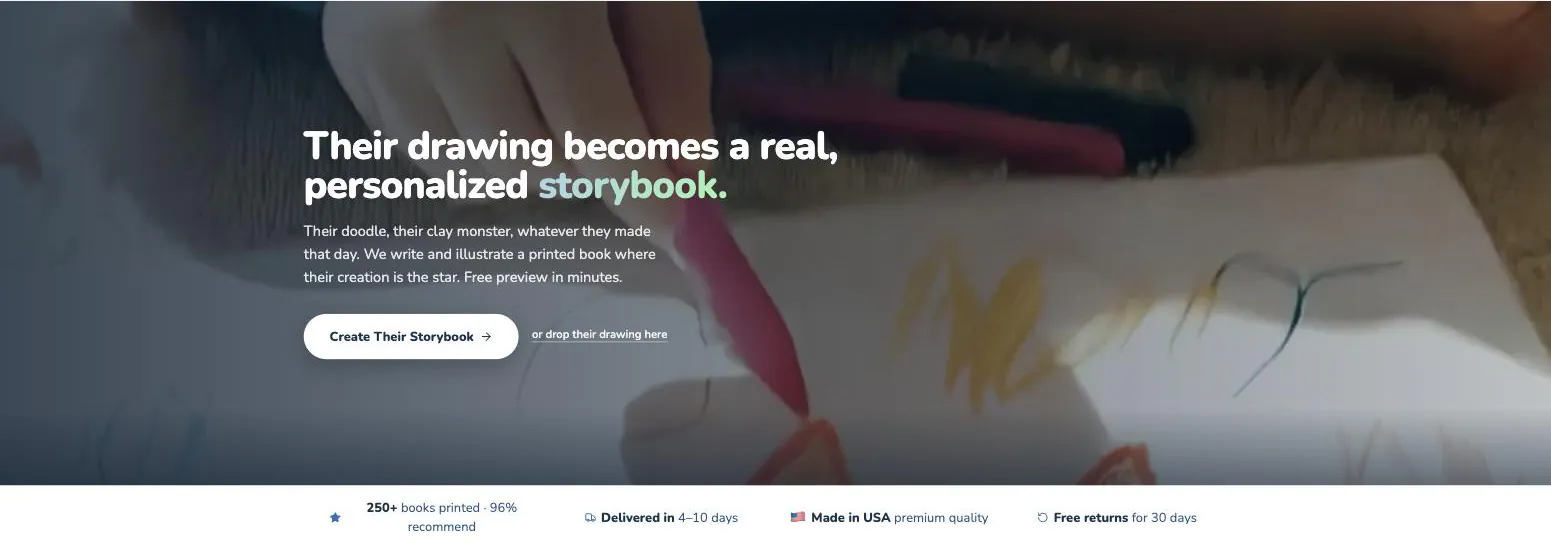
It is a real printed picture book, 8×8 inches, softcover, 30 illustrated pages on silk paper with a matte-laminated cover. You photograph one drawing with a phone and upload it, add the child's name and age, and the story and illustrations are generated around that specific character. The whole thing takes a few minutes.
There is a free preview before any payment, so you see the illustrated version of the drawing and read the full book before committing. If the character comes out looking different from what you pictured, you find out then rather than when the box arrives. No account is needed to get that far.
Digital is $9.99 and the printed softcover is $29.99 with free shipping in the US and Canada, arriving in 4 to 10 days. Full details are on the printed book page and pricing. If you want a sense of how it lands in real families, the reviews are worth a scroll, and 96% of parents who have ordered one say they would recommend it.
The story can center the older child alone, their role and what they are stepping into, or include both children as characters. Follow whichever is truer to how this child is actually feeling about the baby. Enthusiasm and ambivalence both make a good book.
If you are weighing this against other personalized formats, or the older child is at an age where you are unsure it will land, the best age for a personalized book breaks it down stage by stage.
What to ask them to draw
A prompt produces a better result than an open page, and the AAP's advice about involving the child gives you the framing for free. You are not asking them to make a gift. You are asking for their help with something for the family.
The most direct prompt is "draw yourself and the new baby." It does not need to look like anything. Two stick figures, two dinosaurs, two astronauts, all of it works, and the stranger it is the more specific the book becomes.
Others that tend to work: "draw our family with the baby in it," "draw what you want to teach the baby," "draw the house the baby is coming home to." Each gives a subject without prescribing how the drawing should look.
Two practical notes. Bold lines and real color photograph better than faint pencil, though a faint drawing still works if you shoot it flat in good light. And one clear subject reads better than a crowded page. Neither is a rule, just the difference between a good result and a great one. The same shooting advice applies to anything worth keeping, which how to preserve kids' artwork covers in full.
Timing the gift for an older sibling when the new baby arrives
Timing changes what the gift means.
The week before the birth is the best window. The child draws while the family is still waiting, the book arrives before the baby does, and the framing is: you made this, and you did it first. That is the version that fits the AAP's involve-them-early advice most cleanly.
The day the baby comes home is the other strong moment. The house is loud, the attention is elsewhere, and the older child is holding something that is unambiguously theirs on the day everything changed.
Some families use a baby shower, letting the older child see the finished book in front of everyone, which puts them at the middle of a celebration that would otherwise orbit the baby completely.
And if you are the visitor rather than the parent, this is the easiest version of the AAP's suggestion to act on. The book needs nothing from the exhausted adults in the room. You hand it to the older child, they open it, and the moment runs itself.
If the baby is already here and it is going badly
Most articles on this assume you are planning ahead. Plenty of people arrive at the question three weeks in, when the older child has started waking at night again or has begun answering every request with no.
The window has not closed. The AAP frames regression as a check on whether the attention is still available rather than a behavior to correct, and the response it suggests is to give the attention rather than tell the child to act their age. A gift does not substitute for that, but it can carry it. Asking a struggling 4-year-old to draw something for the family is fifteen minutes of one-to-one focus in a month where those are scarce, and it gives them a job at a moment when they mostly feel surplus to requirements.
The book that comes out of it lands differently than one handed over on day one. It is not "welcome to being a big sibling." It is "here is what you made, weeks in, when things were hard." That is the version some children hold onto longer.
Two other moments where a child is asked to share the spotlight and deserves something of their own: a wedding, as flower girl or ring bearer, and Valentine's Day when the classroom exchange leaves them out.
Frequently asked questions
The best gift for an older sibling when a new baby arrives is not the one that keeps them occupied. It is the one that proves they were part of it.
Try it yourself
Turn your child's drawing into a real storybook
Free preview. No account needed. Ships to US & Canada.
Start for free