When the older one isn't adjusting to the new baby
When the older one isn't adjusting to the new baby
Regression, sudden aggression, and a child who was fine for three weeks and then wasn't. What new sibling adjustment actually looks like, and what shortens it.
Protect the older child's role rather than their attention. Most families brace for week one and get ambushed by week five, when the novelty has gone and the permanence has landed. Regression and aggression are usually applications for the care the baby is visibly receiving, so meet the request plainly, keep one thing in the day that belongs only to the older child, and let them be the competent one rather than the displaced one.
The first week is usually fine. That is the part nobody warns you about.
A child meets the baby, is interested in the baby, shows the baby to visitors, and everyone relaxes. Then somewhere around week four or five the same child starts wetting the bed, or asking to be carried up stairs they have climbed alone for a year, or hitting the baby lightly on the head while looking directly at you.
Nothing went wrong in week five. Week five is just when a three year old works out that this is not a visit.
This post is about that stretch, and it is deliberately not a gift guide. If you are looking for the thing to hand the older child on the day, the best gift for an older sibling when a new baby arrives covers that decision on its own terms. What follows is about the months on either side of it.
The thing they actually lost
It is tempting to frame this as competition for attention, and attention is part of it, but it is not the biggest part.
What a first child loses is not hours. It is status. For their entire remembered life they have been the only one, the reference point, the person the household was organized around. That is not vanity, it is simply the world as they found it. A new baby does not reduce that position slightly. It ends the category.
Judy Dunn's work on siblings, much of it built from observing families in their own homes rather than in labs, found that very young children track this with far more sophistication than adults credit them with. Children well under three notice differential treatment, respond to how a parent talks about the sibling, and adjust their own behavior accordingly. They are not confused about what happened. They have understood it precisely.
Which means reassurance framed as "we love you both the same" is answering a question they did not ask. The loss is not of love. It is of a role. Roles are replaceable in a way that reassurance is not, and that is the lever.
Regression is a job application
The behaviors that alarm parents most are usually the most legible ones.
A four year old who has been dry for a year starts wetting the bed. A child who fed themselves asks to be spoon-fed. A confident walker wants carrying. Speech gets babyish. The child asks, sometimes literally, to have a turn in the crib.
Read the pattern and it is not mysterious. The child has observed, correctly, that in this house right now the most intensive care goes to the person who cannot do anything. So they are applying for that job with a demonstration of not being able to do anything.
Refusing the application tends to extend it, because the child concludes the demonstration was not convincing enough and escalates. Making a fuss over it also extends it, for the opposite reason: it worked.
What shortens it is meeting the request flatly and briefly. Yes, you can have a turn in the sling. Yes, I'll carry you up. Said the way you would pass the salt, without the commentary about being a big kid now. The request usually evaporates within a few days once it stops being contested, because what the child wanted was to find out whether that care was still available to them, and a plain yes answers it faster than a negotiation.
The "big kid" framing deserves a specific warning. Promoting the older child on the day the baby arrives sounds encouraging and reads to them as a demotion dressed up, because the promotion arrives with an unmistakable message: the lap is taken.
Aggression needs a boring response
Hitting, pinching, sitting on, and the memorable maneuver of gently placing a heavy object on the baby's chest while maintaining eye contact with you.
Two things at once here. The behavior gets stopped every single time, physically and immediately, with almost no words. And the feeling behind it gets acknowledged at a completely different moment, when nothing is happening.
The reason to separate them is that a long conversation at the moment of impact is, from the child's side, a significant reward. They have just discovered a reliable way to summon your full attention. Keep the interruption short, unexciting and absolutely consistent, and it stops being an efficient tool.
The separate conversation matters just as much and is easier to skip. Later, on the sofa, with the baby elsewhere: you can hate that he's here. That's allowed. You can't hurt him. Both halves are load-bearing. A child who is told the feeling itself is wrong learns to stop reporting it, which does not make the feeling go anywhere.
The Child Mind Institute's guidance on adjusting to a new sibling makes a related point that is easy to get backwards: narrating the baby's behavior in friendly terms ("he's looking at you, he likes it when you do that") does more than instructing the older child to be gentle. One builds a relationship. The other assigns a duty.
Give them a role the baby cannot do
This is the part that does the most work and gets the least airtime.
The older child has lost a position. The fix is a new one that is genuinely theirs, and the requirement is that it be real. Fetching a diaper is real. Being told they are "mommy's big helper" is not a role, it is a compliment with chores attached.
Better versions tend to be the ones with actual authority. They choose which outfit. They pick the song. They decide which book gets read to the baby, and they are allowed to decide it badly. They are the only one who knows how to make the baby stop crying with a particular noise, which may or may not be true and does not matter.
Laurie Kramer's research on sibling relationships has consistently found that the quality of the early relationship is shaped by what children get to do together rather than by rules imposed on them, and that positive engagement predicts the later relationship better than the absence of conflict does. Siblings who fight but also play do better than siblings who are simply kept apart.
Underneath all of these is one structural thing: keep something in the day that existed before the baby and is unchanged by the baby. Ideally something small and daily rather than a monthly outing. The last ten minutes before lights, the walk to the mailbox, the Saturday pancake. Its value is precisely that it did not move. A child who can point to one thing the baby did not take has evidence that the takeover was not total.
What we notice about who the drawing is for
We build personalized storybooks at DoodleTale from children's drawings, and this occasion produces a pattern we did not expect when we started.
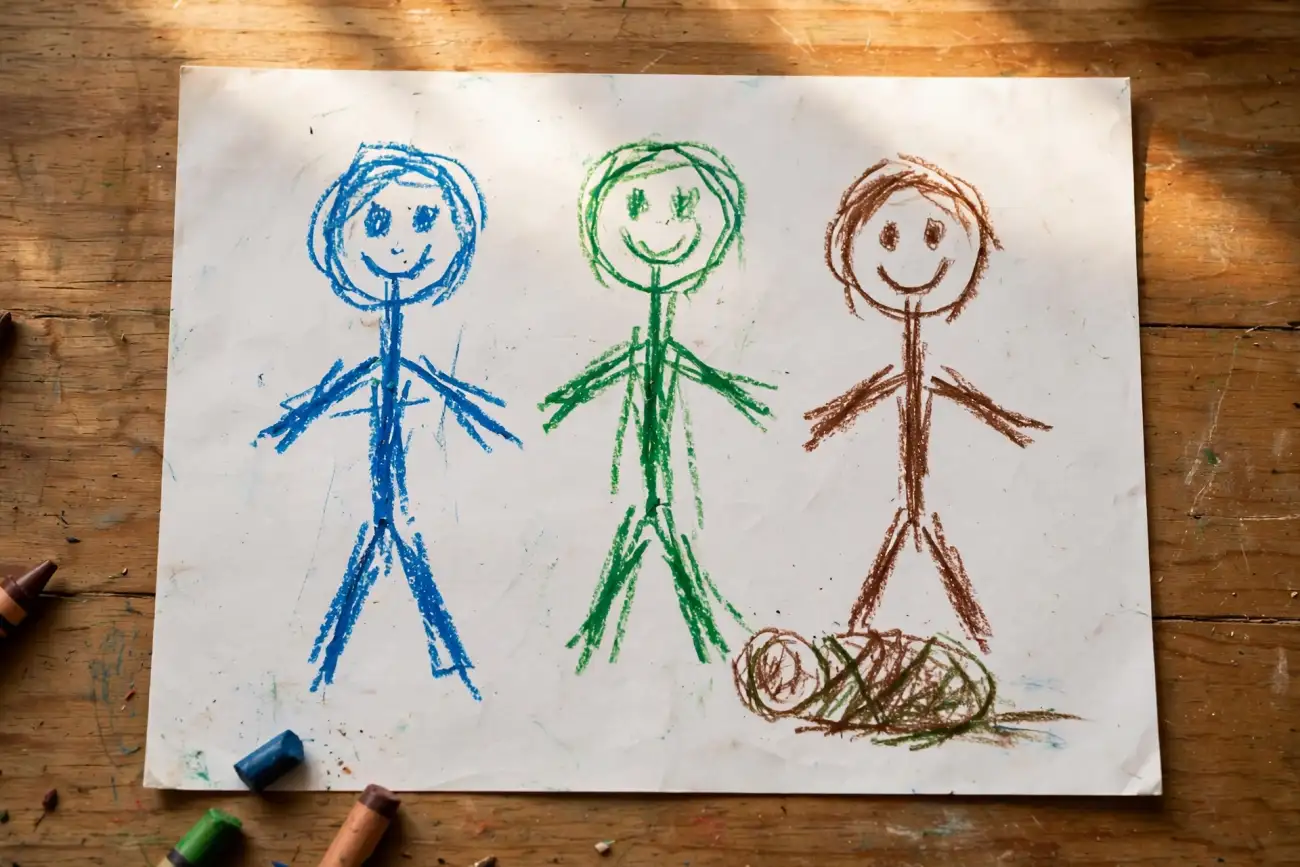
A family with a new baby usually arrives wanting a book for the baby. That is the obvious product. What happens frequently enough that we now plan for it is that the drawing they upload was made by the older child, and partway through the process the whole thing quietly changes direction. The book stops being a gift for the newborn and becomes a book by the four year old, about the creature the four year old invented, with the four year old's name on the cover as the author.
The reason it keeps going that way is structural rather than sentimental. A newborn cannot draw. There is nothing of theirs to build from. The older sibling is the only person in the house who can supply the raw material, and that fact is legible to a four year old immediately. For once, the thing the family is excited about exists because of them and could not have existed otherwise.
That is a different transaction from a gift. A gift is something the adults decided to give, which sits in the same category as the attention being redistributed elsewhere. Authorship is not given. It is simply true, and it cannot be reassigned to the baby later.
We are wary of overclaiming here. A book does not fix a displaced three year old, and anyone selling it that way is selling something. But the older sibling is the only one who can make the drawing, and building the household's next nice thing around their contribution is a straightforward way to hand back a role.
Practical things that measurably help
A short list of the ones that come up again and again, none of which require a program.
Let visitors be redirected. Guests arrive, aim straight for the baby, and the older child watches it happen ten times in a week. Some families keep a small pile of wrapped items by the door for visitors to hand over; simpler is to ask two or three regulars in advance to greet the older one first and ask them about the baby, so they are the source of information rather than the overlooked party.
Do the feeding time deliberately. Feeds are frequent, long, and immobilizing, and they are when the older child reliably goes looking for trouble. Pre-stage that window: a specific basket of things that only comes out during feeds, or a book you read one-handed, or a show if that is the honest answer. The goal is that the feed stops being the reliable hour of being ignored.
Let them see the baby being told no. Older children track fairness closely and conclude the baby has immunity. A visible, spoken correction of the baby, even a theatrical one over something the baby did not intend, evens the ledger more than any amount of explaining that babies don't know better.
Put the older child in the photos of the baby. Not separate photos. The same ones.
Do not attribute the baby's needs to the baby's rank. "I can't right now, the baby needs me" lands as a statement about the hierarchy. "I need two more minutes and then I'm yours" describes time instead, and can be delivered on.
The timeline, roughly
The first week or two often look easy. Week four to eight is usually the hardest part. Most of the visible disruption settles somewhere between three and six months, and it moves in a sawtooth rather than a slope, with two good weeks followed by a bad week that convinces you nothing has improved.
Two later waves catch people off guard. The first is when the baby becomes mobile and starts destroying the older child's things, which is an entirely legitimate grievance and needs a practical answer, usually a shelf or a room the crawler cannot reach. The second is when the baby becomes charming to outsiders and starts collecting the admiration that used to arrive automatically.
Worth raising with your pediatrician: aggression that escalates rather than fades over several months, a child who goes flat and withdrawn rather than angry, or sleeping and eating changes still deepening at three months. Ordinary adjustment is loud and gets better. Persistent withdrawal is quieter and often matters more.
Frequently asked questions
Most of the visible disruption settles within three to six months, though it rarely runs in a straight line. The hardest stretch is often weeks four to eight rather than the first week, because the novelty has worn off by then and the permanence has landed. A child who seems fine at first has not necessarily adjusted yet.
Regression is usually a bid for the kind of care the baby is visibly getting. Asking for a bottle, wetting the bed again, or wanting to be carried are all ways of applying for the role that now looks better funded. It tends to fade fastest when the request is met matter-of-factly rather than refused or fussed over.
It is common and it still needs stopping every time. Aggression at this age is rarely planned malice. It is usually a young child testing what the baby is and what happens next. Keep the response short and unexciting, stay physically between them, and address the feeling separately from the act.
A gift smooths the first day and does not do much for month two. What matters more than the object is whether the child keeps a role that is theirs. If you do give something, make it something that credits them for who they are rather than something that distracts them from what has changed.
Raise it with your pediatrician if aggression toward the baby is escalating rather than fading after a few months, if the older child seems persistently flat or withdrawn rather than angry, or if sleeping and eating changes are still deepening at the three-month mark. Ordinary adjustment gets messy and then gets better.
If the older child is drawing their way through this, what kids' drawings reveal about them is a useful companion, and helping a kid with big feelings covers the in-the-moment half of what this post describes.
They did not lose your attention. They lost their job. Give them a different one.
Try it yourself
Turn your child's drawing into a real storybook
Free preview. No account needed. Ships to US & Canada.
Start for free