What to say when your child shows you a drawing (when "good job" isn't enough)
What to say when your child shows you a drawing (when "good job" isn't enough)
What to say when your child shows you a drawing: specific phrases for when you're busy, can't tell what it is, or a sibling is listening, backed by praise research.


Turn your child’s drawing into a book
Free preview, no account needed.
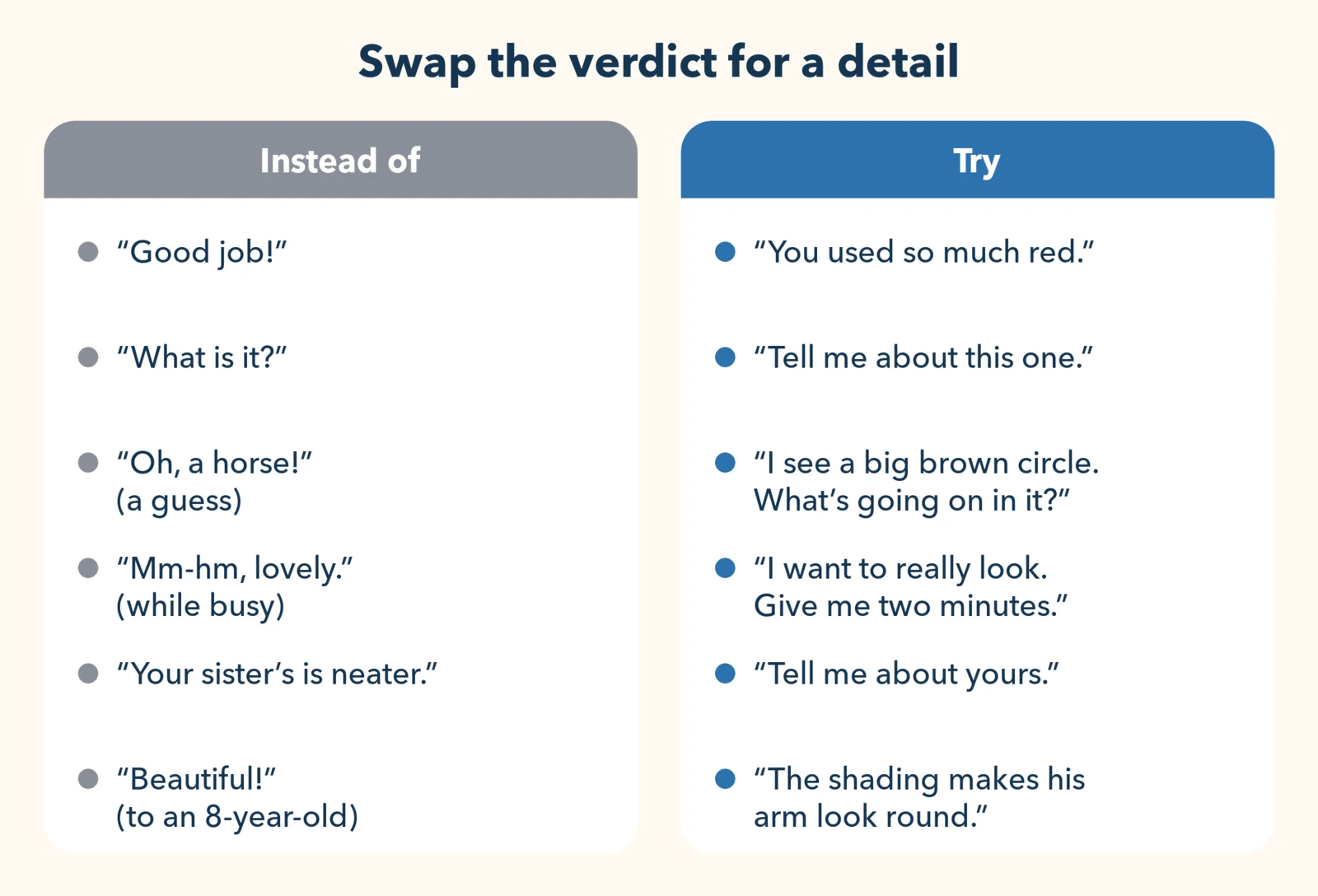
Say one specific thing you actually see, then ask an open question. "You used so much red. Tell me about this one." works better than "Good job!" because it proves you looked and hands the story back to your child. Avoid "What is it?" and avoid inflated praise like "incredibly beautiful," which research shows can make less confident kids avoid challenges. If you're busy, say so and come back in two minutes. If a sibling is listening, talk about each drawing on its own terms.
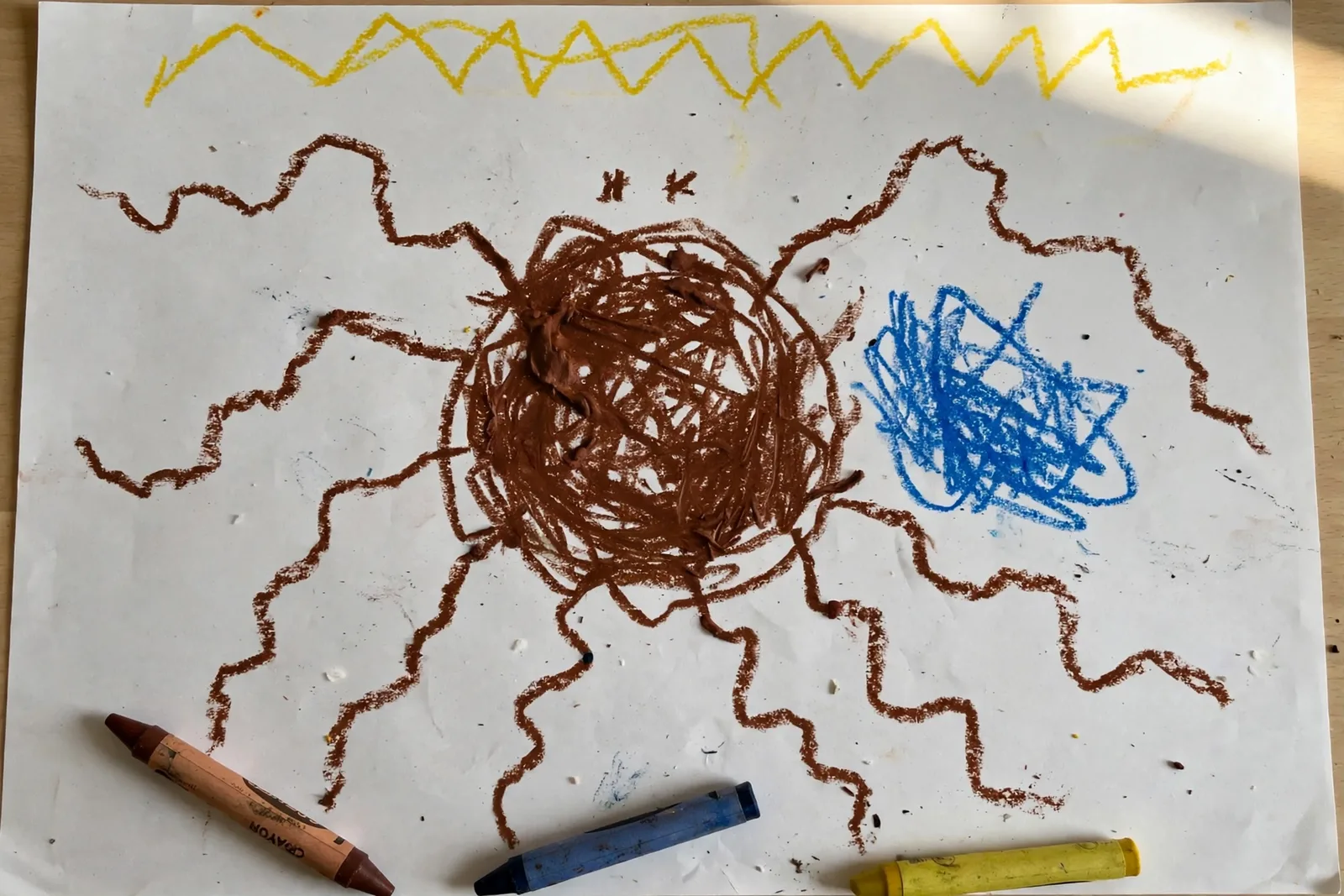
Your four-year-old appears at your elbow holding a page with a big brown circle and a lot of long squiggly lines. You are halfway through an email. The words come out on their own: "Wow, great job!" Your child walks away, and you have the faint sense you missed something.
You did, a little. "Great job" isn't harmful, but it tells a child nothing about what you noticed, and children can hear when praise is running on autopilot. The good news is that the fix takes about five seconds and doesn't require a vocabulary of art terms. It requires one true sentence about the drawing and one question.
Why "good job" falls flat
There are two ways to respond to a drawing. You can rate it ("beautiful," "perfect," "so good") or you can notice it ("the dog has a really long tail"). Rating puts your verdict at the center. Noticing puts the drawing there.
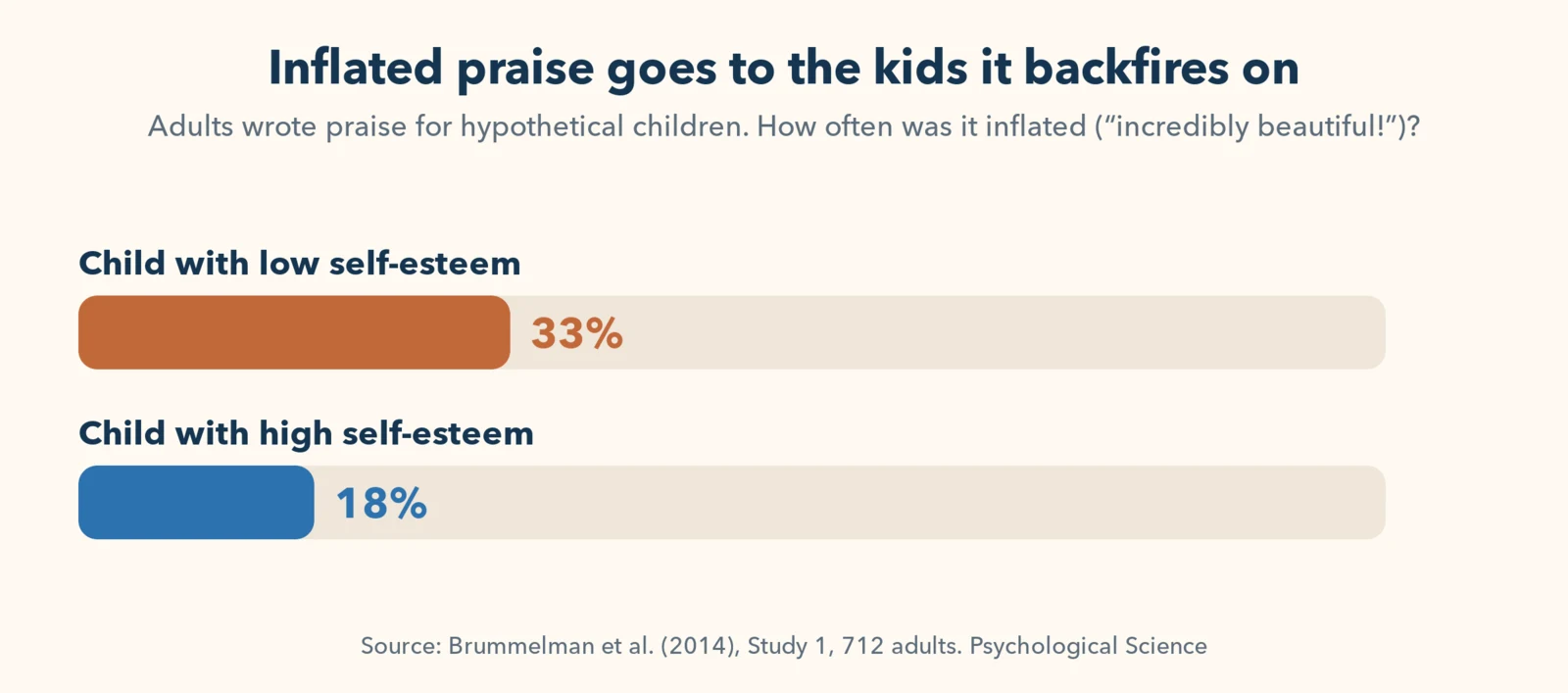
The research on this is unusually specific to drawings. In a 2014 study, a Dutch-led team headed by Eddie Brummelman started from the observation that "in current Western society, children are often lavished with inflated praise (e.g., 'You made an incredibly beautiful drawing!')." In one experiment, 240 children aged 8 to 12 copied Van Gogh's Wild Roses and then received a note from a "professional painter" with inflated praise, ordinary praise, or no praise. The results were published in Psychological Science: "inflated praise decreases challenge seeking in children with low self-esteem and has the opposite effect on children with high self-esteem." The authors concluded that inflated praise, "although well intended, may cause children with low self-esteem to avoid crucial learning experiences."
In other words, the kids who most need encouragement may be the ones most likely to hear "incredibly beautiful" as a standard they now have to protect. The safest move, from where they sit, is to pick an easier picture next time.
The same paper found that inflated praise tends to land on exactly the wrong kids. When adults were asked to write praise for hypothetical children, they chose the inflated kind far more often for children described as having low self-esteem.
A second line of research points the same way. Carol Dweck and Claudia Mueller found that praising children for being smart rather than for their effort left them, after a setback, with "less task persistence, less task enjoyment" and "worse task performance." 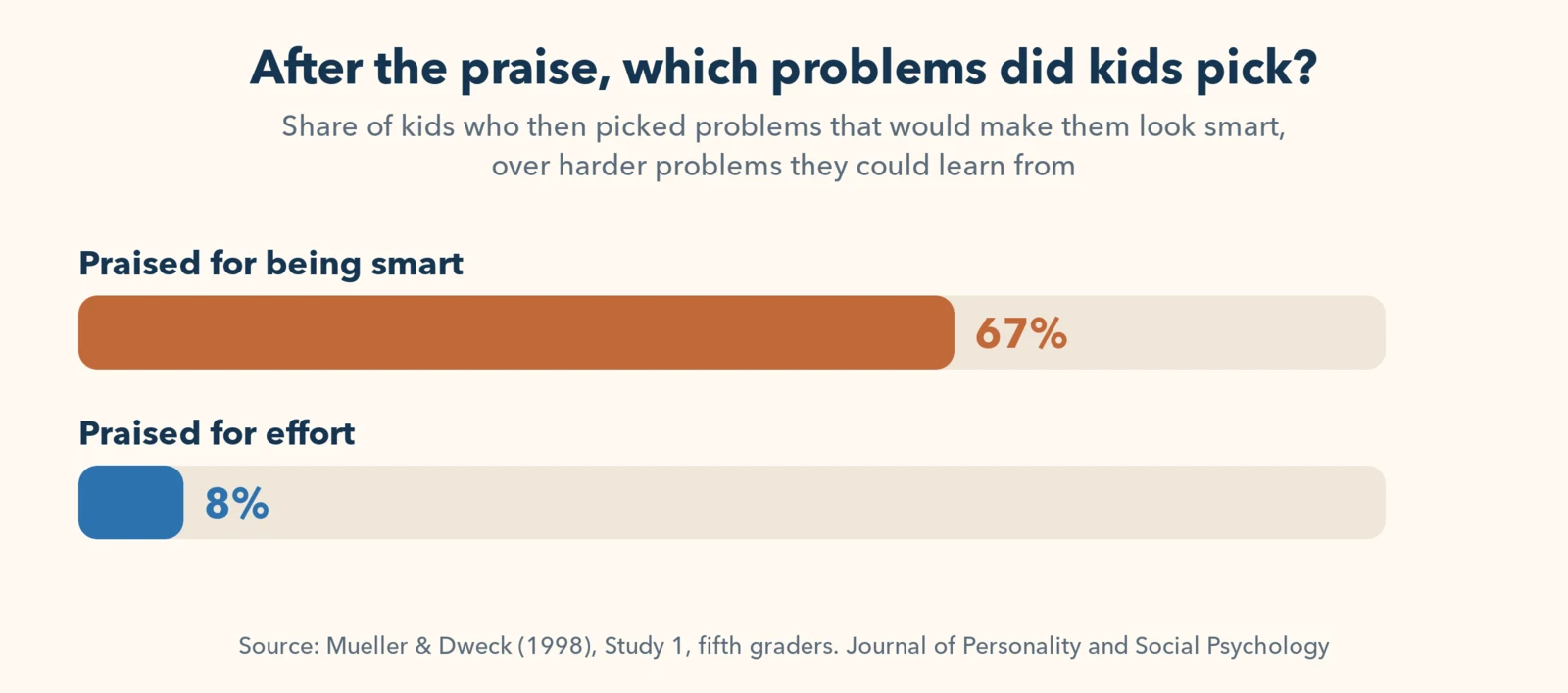
That study was with fifth graders, but a follow-up by Melissa Kamins and Dweck, in which kindergartners role-played getting feedback from a teacher, found a similar pattern: praise aimed at the child rather than what they did ("you're really good at this") left them more helpless after a setback. Person praise, the authors wrote, "can create vulnerability and a sense of contingent self-worth."
None of this means praise is bad. A large review of the research found that positive feedback raised interest overall, though for children the effect on what they freely chose to do was close to zero. Praise doesn't hurt, and it doesn't do as much as we assume. The trouble is with two specific kinds: praise that is inflated, and praise about who the child is rather than what is on the paper.
The five-second version
Say what you see, then ask.
The writer Alfie Kohn, in his widely shared essay Five Reasons to Stop Saying "Good Job!", suggests giving "feedback – not judgment – about what you noticed: 'This mountain is huge!' 'Boy, you sure used a lot of purple today!'" He goes one step further: "Even better than descriptions are questions. Why tell him what part of his drawing impressed you when you can ask him what he likes best about it?"
That's the whole method. Everything below is just how it plays out in the moments that make it hard.
What to say, moment by moment
When you're busy
This is when most "good job"s happen, and it's fine to be busy. What doesn't work is pretending to look. "I want to really look at this. Give me two minutes to finish this email" is honest, and it tells your child the drawing deserves your full attention. Then actually come back.
The Harvard Center on the Developing Child calls these small exchanges serve and return, and describes them as "responsive, back-and-forth exchanges between a young child and a caring adult" that "play a key role in shaping brain architecture." A drawing held up at your elbow is a serve. A delayed but real return counts. A distracted one mostly doesn't.
When you honestly can't tell what it is
Don't guess. Guessing wrong ("What a lovely horse!" when it's Grandma) lands badly, and guessing right by luck teaches nothing. Don't ask "What is it?" either. The Columbus Museum of Art's guide for parents puts it well: "Resist the urge to ask What is it? That phrase suggests that the child has not been successful or that the work must represent an object."
Describe the marks instead: "I see a big brown circle with lots of wiggly lines, and a blue part next to it. Tell me what's going on." The museum's handout also suggests "What were you thinking about when you made this?" Most kids are delighted to explain. Some will tell you it's a spider who is sad because it rained. Some will tell you it's "just colors," which is also a complete answer.
When it's a gift for you
A three-year-old who hands you a drawing isn't asking for a review. They are giving you something. "Thank you. I love having this" is complete, and so is telling them where it will go: "This is going on my desk at work."
The destination matters more than the words. A drawing that ends up somewhere, a card in Grandma's mailbox or a page in a book, tells a child it mattered more convincingly than any adjective.
When a sibling is listening
This is where well-meant comments go wrong fastest. "Your sister's is so neat!" said to one child is heard by both. Praise works best, according to a review by psychologists Jennifer Henderlong and Mark Lepper, when it "enhances competence without an overreliance on social comparisons."
Talk about each drawing on its own terms, and ask each child about their own. Adele Faber and Elaine Mazlish, authors of How to Talk So Kids Will Listen, suggest switching siblings "from the distress of competing with each other" to "the satisfaction of competing with themselves." For drawings, that sounds like "You've never drawn a horse running before" instead of "That's better than hers."
When they ask, "Is it good?"
Answer honestly and specifically, then hand the question back. "I love how fierce the dragon's face is. Which part do you like best?" Kohn suggests questions like "What was the hardest part to draw?" because they get a child thinking about their own work instead of waiting for yours.
If the question comes with a frown, or the drawing is about to go in the trash, it's usually a different conversation. What to say when a kid says they're bad at drawing covers that one.
What it sounds like at each age
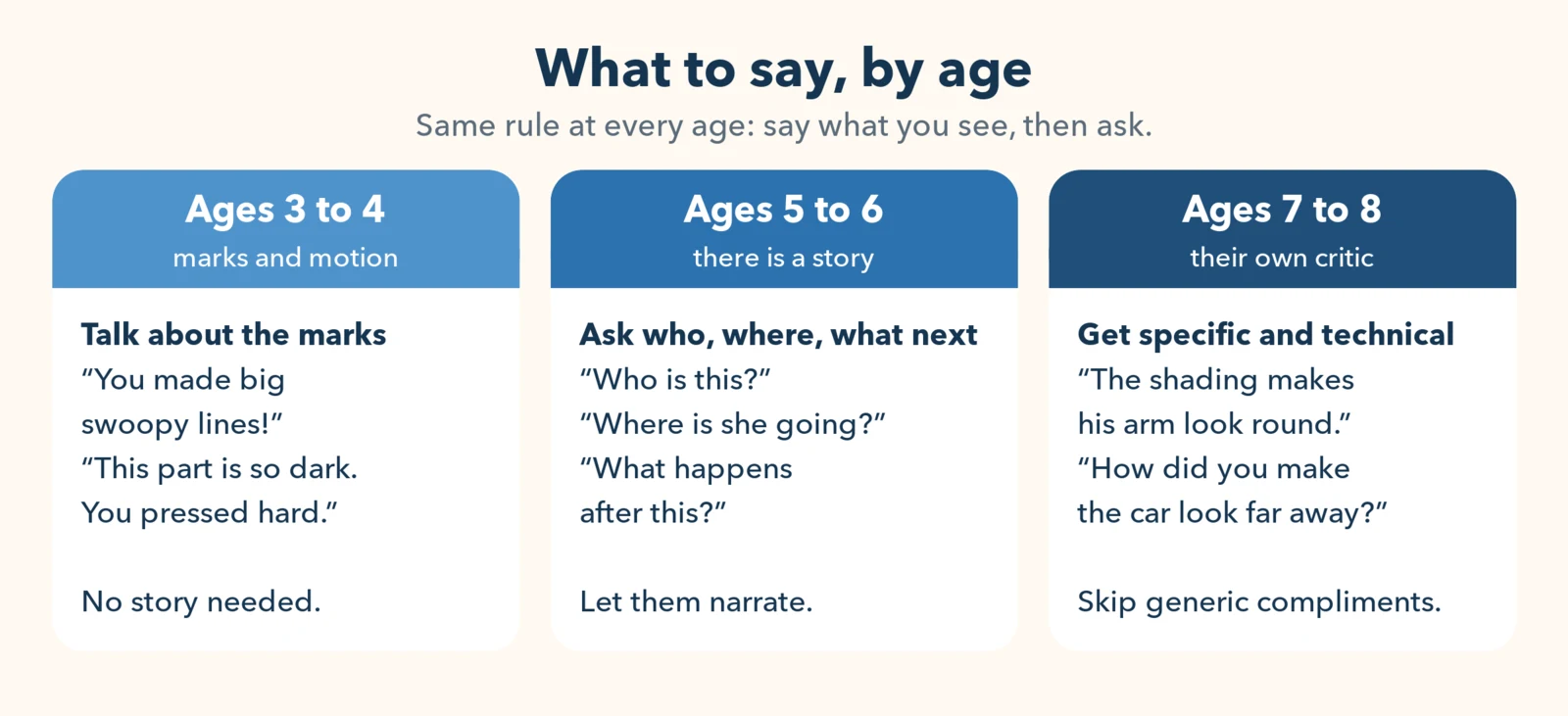
Ages 3 to 4. Young children often aren't drawing something. They are making marks and enjoying how their arm moves. Talk about the marks: "You made big swoopy lines!" "This part is so dark, you pressed hard." Then leave it there. You don't need a story if there isn't one.
Ages 5 to 6. Now there is often a story, and the drawing is only part of it. Ask who, where, and what happens next. The big brown circle may turn out to be a bear named Biscuit who lives in the library, and you will get more out of "What is Biscuit doing today?" than out of any compliment. If the same character keeps coming back every day, why kids draw the same thing over and over explains what's going on.
Ages 7 to 8. Around seven to nine, many children start judging their own work against how things really look, and many start to notice when an adult is just being nice. Generic compliments bounce off. Get technical and specific: "The shading on his arm makes it look round." "You figured out how to make the car look far away." That shows you see what they were trying to do, which is the only praise that registers now.
A drawing that goes somewhere
Words are the first response. What happens to the drawing next is the second, and it often matters more. How to encourage kids to draw more makes the case that kids keep drawing when their drawings have somewhere to go, not when they collect more compliments.
That can be as simple as a frame or a card mailed to a grandparent. It can also be bigger. DoodleTale turns one of your child's drawings into a printed storybook where their character is the hero, so Biscuit the library bear gets an actual adventure. For a five-year-old, seeing a drawing become a real book says "this mattered" more clearly than any adjective you could find in the moment.
Say one specific thing you actually see, such as a color, a detail, or how something seems to move, and then ask an open question like "Tell me about this one." Specific words show a child you really looked, and the question hands the conversation back to them.
Try describing it ("You used so much purple"), asking about it ("What was the hardest part to draw?"), or naming the effort ("You worked on those windows for a long time"). Each one tells the child something real about what you noticed, instead of handing out a grade.
"What is it?" can suggest the drawing failed to explain itself, or that it has to be a picture of something. Many young children are exploring marks and color, not drawing an object. "Tell me about your picture" invites the same information without implying the drawing fell short.
No. Praise isn't harmful, though research suggests its motivational boost for children is small. The bigger finding is about two specific kinds of praise to use carefully: inflated praise ("incredibly beautiful!") and praise about the child's talent rather than what they did. Specific, honest praise about the drawing itself is fine.
Answer honestly and specifically, then turn the question around. "I love how fierce the dragon's face is. Which part do you like best?" That gives them something real and teaches them to judge their own work, which matters more as they get older and start doubting your compliments.
Tonight, put the phone down for ten seconds and say one true thing about the drawing in your kid's hand.
Try it yourself
Turn your child's drawing into a real storybook
Free preview. No account needed. Ships to US & Canada.