
Artkive alternative: what it really costs and what parents switch to
Artkive alternative: what it really costs and what parents switch to
Artkive's box is $39 and its books start at $75, but the final bill is set by how much art you pack. Here's the full cost math and the alternatives, including one that never asks you to mail anything.
It depends on which problem you have. If you want the same concierge job done with pricing you can see up front, Plum Print is the closest match. If you want the archive without the box, an app like Pixyit does it from phone photos for about $4 a month, and photographing everything yourself and printing a photo book costs less still. If what you actually want is for one drawing to become something a child reads rather than a catalog of three hundred, DoodleTale turns a single uploaded drawing into a printed storybook for $29.99 and nothing gets mailed.
Most people who search for an Artkive alternative have already been to the pricing page. The box looked reasonable, the book looked reasonable, and then somewhere between those two numbers and the size of the pile in the cupboard, the arithmetic stopped being reassuring.
This is that arithmetic, laid out completely, plus the options that solve the same problem a different way. All prices below were re-checked on Artkive's own pricing page on 23 August 2026.
One thing has changed since this post first went up. Artkive is currently running a back-to-school offer that drops the box from $39 to $11, claimed with an emailed code. It is worth taking if you were going to order anyway, and it changes the entry total rather less than it looks, for the reason the next two sections explain: the box was never where the money was.
What Artkive actually charges
Artkive sells a service, not a product, and the service is that somebody else does the tedious part. You order a box, fill it, ship it back with a prepaid label, and they photograph every piece, build a proof, and print a hardcover.
The published prices are straightforward on their own. The box is $39, which covers the physical box and the shipping. An art book starts at $75 for 25 pieces and scales up from there to a maximum of 350 images per volume. Digitization without a book starts at $45 for 25 pieces, and framed mosaics are $149 for the small size or $249 for the large, dropping to $99 and $189 when bundled with a book.
The add-ons matter more than they look. Having your original artwork shipped back to you is $20. A USB drive of the high-resolution images is $25. Extra copies of the book are 60% off.
So the honest entry point is $114 at list price: box plus a 25-piece book. Artkive sells a gift card at exactly that price, which is a useful confirmation that $114 is the real floor rather than $75. With the current $11 box offer the floor is $86, and the book half of that total does not move.
The full ladder is published in Artkive's own pricing FAQ, and it is worth reading before you start filling anything, because it is the number nobody quotes:
| Pieces in the book | Book price | Per piece |
|---|---|---|
| 20 to 25 | $75 | $3.00 to $3.75 |
| 50 | $160 | $3.20 |
| 100 | $265 | $2.65 |
| 200 | $455 | $2.28 |
| 300 | $645 | $2.15 |
| 350 | $740 | $2.11 |
Their own slider says the same thing if you drag it, which is the quickest way to price your actual pile before you commit to anything.

Add the $39 box once, or $11 during the current promotion, and note that the slider price is per book. Two 50-piece books, one per child, is $320 rather than the $160 a single 100-piece book would cost, so families with two children pay a real premium for keeping the collections separate.
The clause that decides your final bill
Here is the part that no comparison page seems to spell out, and it is the whole ballgame.
Artkive's pricing page states that every piece of art you send in will be photographed and included in your order, and that removing images from a book or mosaic proof will not change the cost. The FAQ goes further: orders may not be cancelled after your art has been sent. Your bill is therefore set at the moment you tape the box shut, not at the moment you review the proof. The proof stage lets you change the layout. It does not let you change the price.
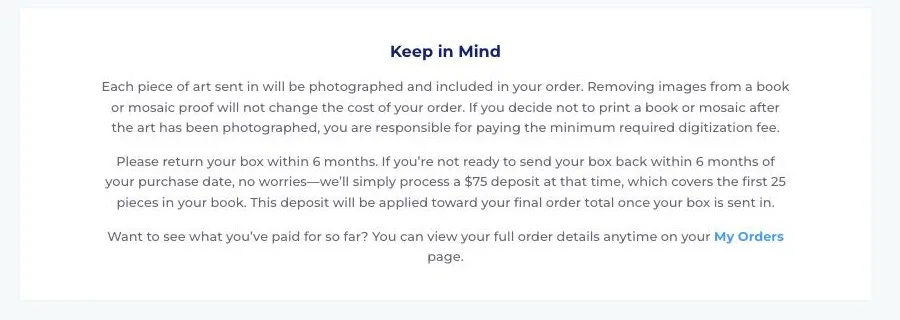
There is also a counting rule that catches people out. Anything needing more than one photograph to capture, meaning double-sided art, booklets and cards, counts as multiple pieces for pricing. A folded birthday card your child made is two pieces unless you leave a note in the box saying you only want one side.
There is a second clause worth knowing before you order. If your box is not returned within six months of purchase, Artkive processes a $75 deposit at that point, which covers the first 25 pieces and is applied as credit toward the final order. It is not a penalty exactly, but it is a charge that arrives while the box is still sitting empty in your hallway.
Put those together and the failure mode becomes obvious. A parent orders the box in February, means to curate carefully, ends up tipping in most of a drawer in September, and gets a bill sized for a drawer. Customer reviews on the company's BBB profile run to 1.64 out of 5 across 25 reviews, and the recurring theme is exactly this gap between the entry price and the final total, with several reviewers describing bills in the hundreds after an initial payment under $200.
None of that makes Artkive a bad service. The books are genuinely well made, the photography is professional, and the reviewers who used the pricing slider first are the ones who came away happy. It makes it a service where the important decision happens earlier than most parents expect, in the packing, not in the proofing.
How to keep the bill down if you use Artkive anyway
If the concierge service is still what you want, four things change the total, and three of them happen before you ship.
Curate on the floor, not in the proof. Because every piece photographed is billed and pulling images out of the proof does not reduce the cost, the sorting has to happen while the art is still on your carpet. Sort into keep, photograph-at-home, and recycle, and only the first pile goes in the box.
Note the single-side instruction. Because double-sided art and cards count as multiple pieces, a note in the box saying which side you want captured is worth real money on a pile full of folded cards.
Consider digitization only. At $45 for 25 pieces it is the cheapest way to get everything captured professionally, and you can decide on a book or a mosaic later once you have seen the images. It splits one large decision into two smaller ones.
Order the extra copies at the same time. Additional copies are 60% off, which is the one place the pricing works in your favour, and it is usually cheaper than any second gift you were going to buy the grandparents.
Why parents look for an alternative
Three reasons come up, and they lead to three different answers.
The price for the volume you have. You counted the drawings, multiplied, and decided the archive is worth less to you than what it costs. This is a budget problem with several clean solutions.
Mailing the originals. Everything your child has made goes in one box and travels across the country, and getting it back is a $20 option you have to choose deliberately. Some parents simply will not put the originals in a truck, which is a completely reasonable position.
Realizing you do not want an archive. This one takes longer to surface. You start out wanting to preserve everything, then notice that what you actually keep looking at is one drawing, and that a bound catalog of three hundred pieces is not the thing you were imagining. That is not a cheaper version of the same problem. It is a different problem.
If you want the same job done, with clearer pricing
Plum Print is the closest equivalent, and its appeal is predictability rather than price. The kit is a $49.99 deposit that applies to your order. A 10x8 hardcover starts at $175 with a 20-piece minimum and runs roughly $2.60 per additional piece, and their site has a slider that shows you the total before you commit anything.
For a large collection, the per-piece math is defensible at either service. Someone photographed several hundred pieces of paper individually, corrected the color, laid them out, and bound the result. That is a real job and it costs real money.
Where both mail-in services get expensive is at the bottom of the range. Twenty-five pieces at Artkive works out to about $4.56 each once the box is counted. For a small, carefully chosen collection, you are paying concierge rates for a job you could do in an afternoon. The mechanics of the mail-in route, from kit to proof to the two-month timeline, are covered in full in send kids' artwork to make a book.
If you want the archive without the box
An entire category of apps does the capture side with your phone and skips the shipping entirely.
Pixyit is the most interesting of the current crop because it records something the mail-in services throw away. You photograph the artwork and then record the story behind it, what your child says the thing is, which is frequently the best part and the first part to disappear. The free tier holds 25 artworks with their stories. Unlimited is $4 a month or $48 a year, and the annual plan includes an 8x8 art book each year that they price at $35 on its own.

Set that against Artkive's floor of $114 for a 25-piece book, and a year of Pixyit with the book included lands at less than half. What you give up is the professional photography, the background removal on every piece, and having somebody else do the work.
The free version of this is older and still works. Photograph each drawing flat, in daylight, phone directly overhead. Keep them in one album per year. When the album is full, send it to a photo book service; Blurb and Shutterfly both start in the $40 to $50 range. Every drawing carries a bit of your kitchen table with it, which bothers some parents and charms others. It is also roughly where most parents on Reddit land when the pile gets out of hand.
Whichever route you pick, do the photographing first if anything is going in a box. Their scan is not your backup, and how to preserve kids' artwork covers getting clean shots without a scanner.
If one drawing is what you actually care about
This is the alternative the other comparison pages leave out, because every service on their lists is solving the storage problem.
DoodleTale starts from the opposite end. You photograph one drawing, upload it, and it generates a printed storybook where that specific drawing becomes the main character and your child is the named hero of the story. Any medium counts, crayon, marker, paint, or a photo of something they built out of clay or cardboard. The printed book is an 8x8 softcover, 30 illustrated pages, $29.99 with free shipping in the US and Canada in 4 to 10 days, or $9.99 for the digital version. There is a free preview of the character, the full story, and the cover before you pay, and no account needed to see it. Specifications are on the printed books page.
Nothing is mailed, so the original stays on the fridge with its curl and its crease, and there is no return-shipping add-on to remember.
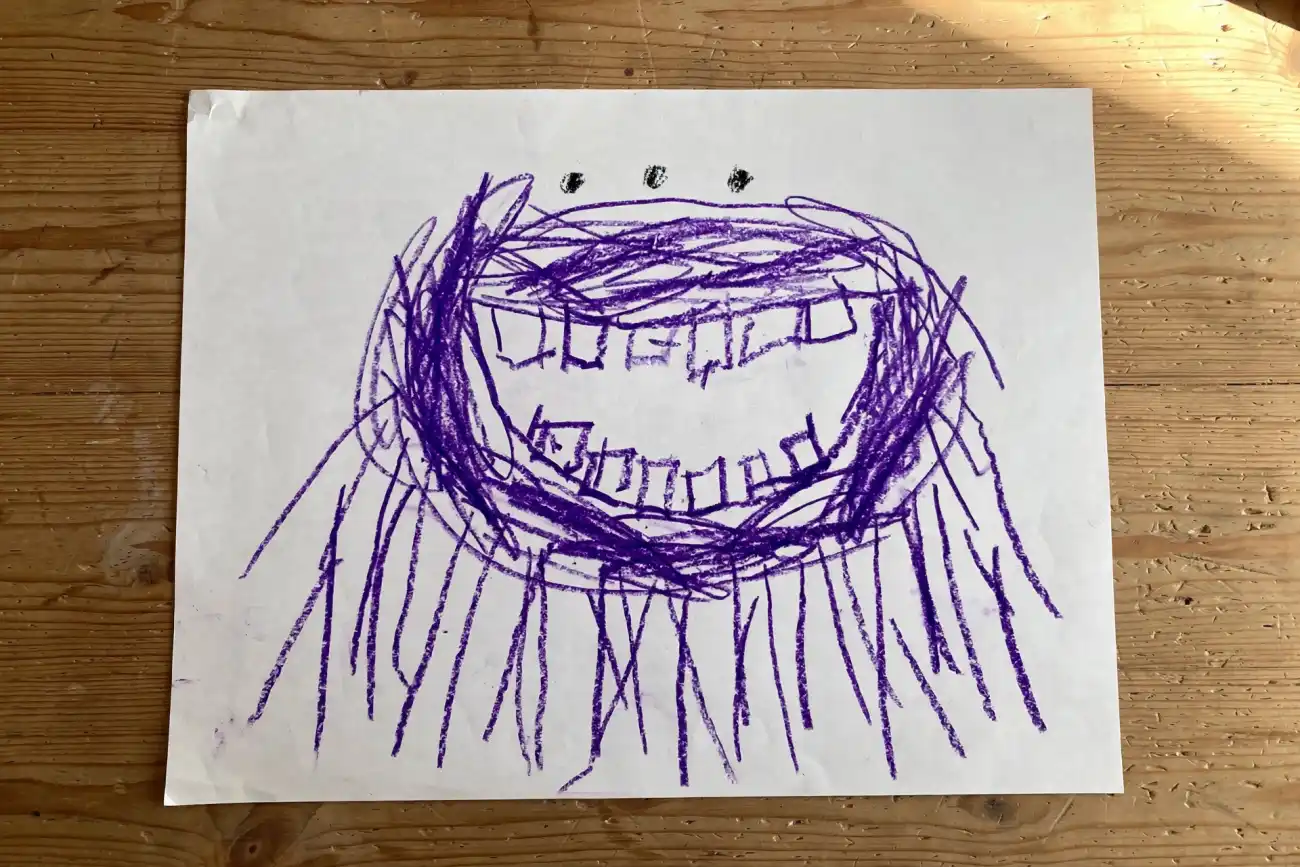
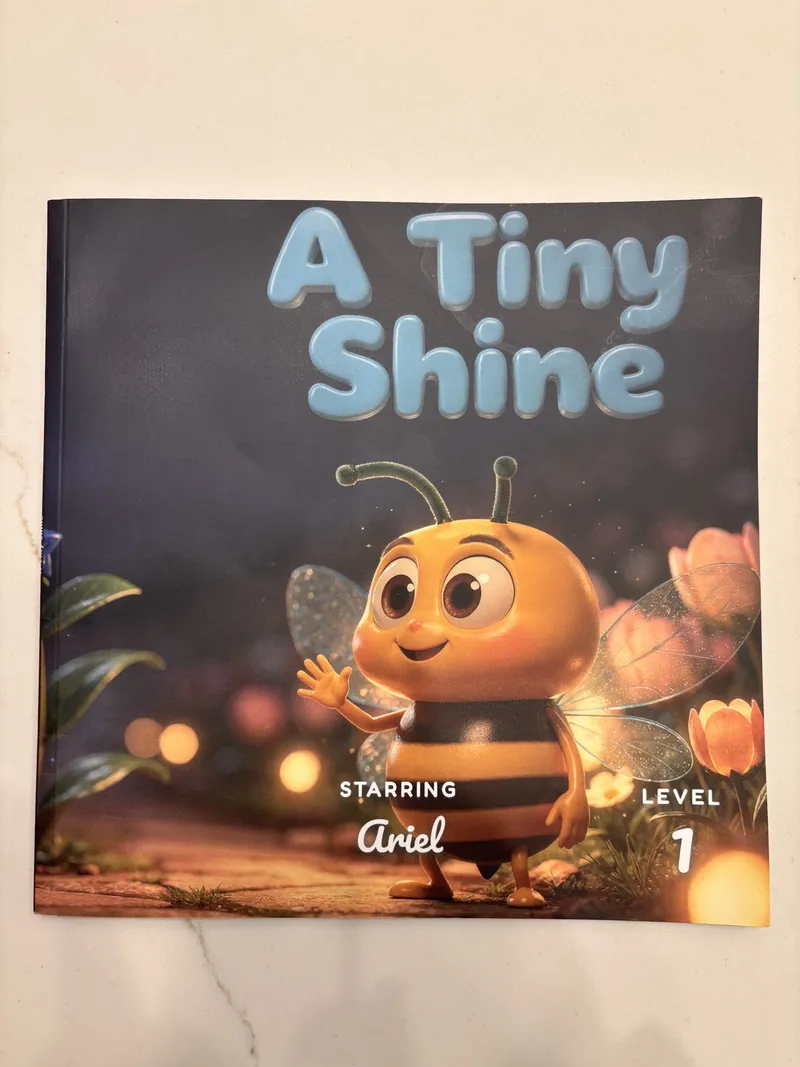
The output is the difference, not the logistics. An Artkive book is a catalog: page after page of reproductions, arranged by date, which is exactly right if the goal is to get the cupboard under control. A storybook made from one drawing is a narrative that a five-year-old carries to you at bedtime because the monster in it is theirs. One is a thing parents show visitors. The other is a thing children read.
Two other services work from drawings and are worth naming honestly, because neither is a keepsake in the same sense. Drawtopia sells an annual membership at $149 for digital stories with some physical books included, though as of this writing its site still advertises a platform launch dated May 2025. Scribblo is an app at $2.99 to $9.99 a month that turns a drawn or uploaded character into illustrated digital stories with narration and coloring pages, and it does not print a bound book at all. If a subscription is the model you are weighing, personalized storybook subscription vs keepsake works through that economics properly.
What it costs per drawing
The comparison that matters is not the sticker price, it is what you pay per piece of paper and what you get back.
| Artkive | Plum Print | Pixyit | DIY photo book | DoodleTale | |
|---|---|---|---|---|---|
| Entry cost | $39 box + $75 book | $175 book (kit deposit credited) | Free to 25 pieces | ~$45 for the book | $29.99 printed |
| Per piece at entry | ~$4.56 | ~$8.75 | $0, then $4/mo | pennies | n/a, one drawing |
| Mail your originals | Yes | Yes | No | No | No |
| Originals returned | $20 add-on | Paid option | n/a | n/a | Never leave home |
| Who photographs | They do | They do | You do | You do | You do, one photo |
| What you get | Archive book | Archive book | Gallery + yearly book | Photo book | Storybook with a plot |
Plum Print's per-piece figure looks worse only because its minimum book is larger; at 100 pieces the two mail-in services converge.
Which one fits
Count the drawings, then decide what you want them to become.
Hundreds of pieces, no system, and no appetite for the work: mail-in is genuinely the right tool. Use the pricing slider first, choose the originals-return option explicitly, and start a full season before any date you care about.
A steady flow you want captured as it happens: an app like Pixyit, or a phone album and one photo book a year. Cheaper, slower to feel finished, and the only version that keeps up with a child who draws daily.
One drawing that stopped you: none of the archive services are built for this, and paying $114 to bind a single piece of paper would be an odd way to spend an afternoon. Upload it, keep the paper, and let it become a story instead. The pricing page has both options on it.
Plenty of families end up doing two of these, years apart. The archive solves the volume problem once. The storybook was never about volume.
If what you actually wanted was the drawing moving rather than archived, that's a different market with different economics: every tool that brings drawings to life, compared.
Frequently asked questions
For a large backlog, yes, if you go in with the total already worked out. The box is $39 and a 25-piece book is $75, so the entry point is about $114 before add-ons. The complaints that exist are almost always about the gap between that entry price and a final bill set by how many pieces went in the box, so use Artkive's own pricing slider before you seal it.
Photographing the drawings yourself and uploading them to a photo book service. Blurb and Shutterfly books start in the $40 to $50 range, and the only cost beyond that is an afternoon of shooting. You lose the professional lighting and the background removal, which most parents decide they can live with.
Several. Pixyit and similar apps archive from phone photos for a few dollars a month, and DoodleTale turns a single drawing into a printed storybook from one uploaded photo. Nothing ships, so the paper never leaves your house and there is no return-shipping add-on to remember.
Artkive is cheaper to start and Plum Print is more predictable. Artkive is $39 for the box plus $75 for a 25-piece book. Plum Print takes a $49.99 kit deposit that applies to your order, then starts at $175 for a 10x8 hardcover with a 20-piece minimum and roughly $2.60 per piece after. Plum Print's slider shows the total before you commit.
The drawing worth keeping is rarely the one that photographs best. It is usually the one with the fold in it, from the afternoon you remember.
Related: Send kids' artwork to make a book: what to know before you mail · How to make a book from kids' artwork · How to preserve kids' artwork · Best gifts made from kids' artwork
Try it yourself
Turn your child's drawing into a real storybook
Free preview. No account needed. Ships to US & Canada.
Start for free