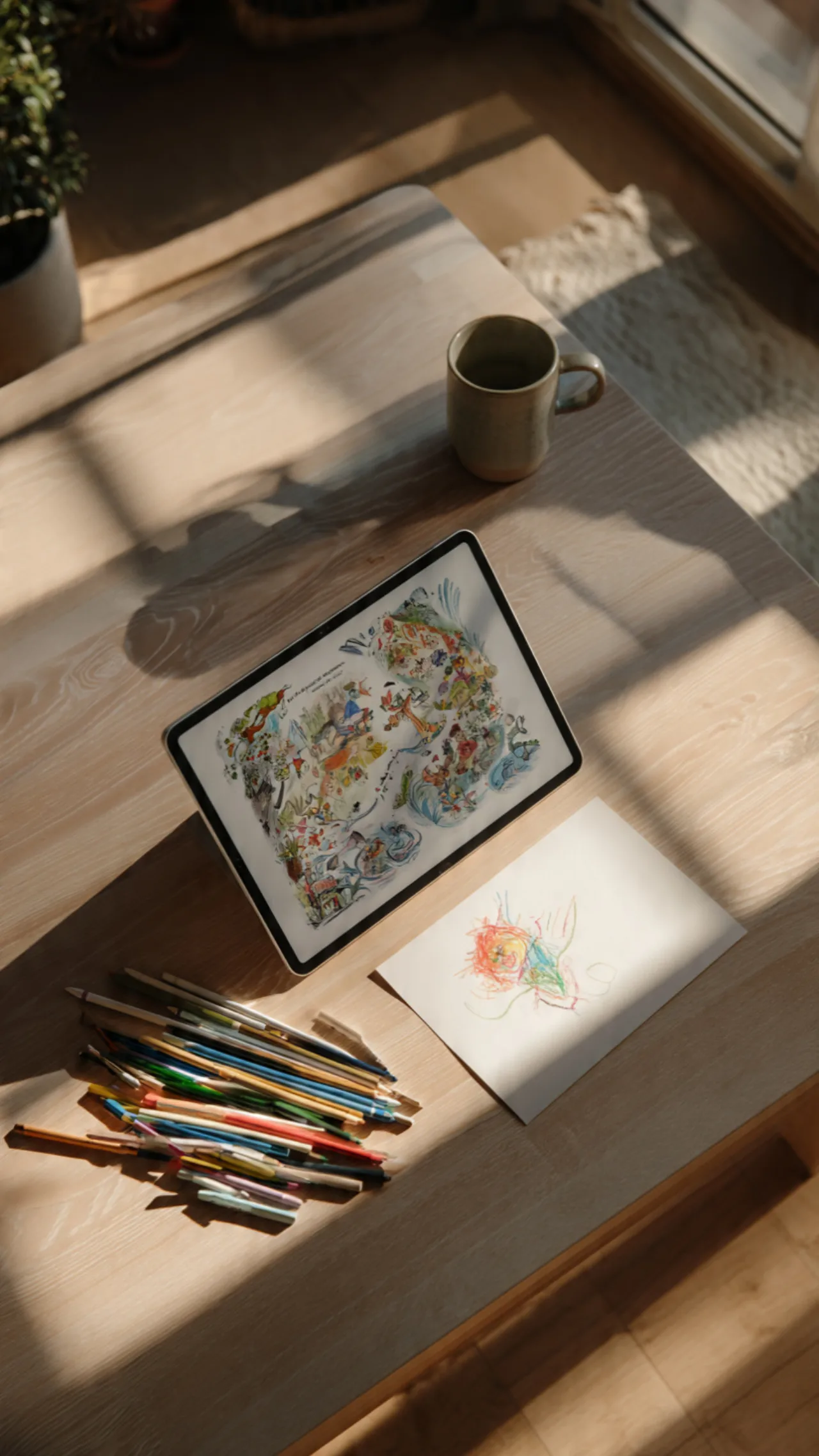
How to make a book from your kids' artwork (before they outgrow the crayon phase)
How to make a book from your kids' artwork (before they outgrow the crayon phase)
Make a book from kids' artwork three ways: a DIY photobook, a mail-in service, or an AI storybook where one drawing becomes the character. What each costs and who it fits.
There are three main routes. Photograph the art and lay out a photobook yourself (cheapest, around $30 to $60, most effort), use a mail-in service like Artkive that handles the photography and printing for you (around $100 and up), or upload one drawing to DoodleTale and turn it into a personalized storybook where the drawing becomes a character. Which one fits comes down to whether you want an archive of everything or one meaningful book built around a favorite piece.
Most parents have a drawer, or a pile, of their kid's art. Crayon suns with stick-figure families. Marker monsters. That one horse they are inexplicably proud of. By the time a kid is six or seven, the stack is genuinely large, and most of it ends up recycled. Not because parents don't care, but because nobody has a system, and a loose pile of paper is easy to lose track of.
Making a book changes that. A book has a spine. It goes on a shelf. Kids come back to it, which a folder in a closet never gets. The question is which kind of book, because there are really three different ones, and they solve different problems.
Three ways to turn drawings into a book
The options split by goal. Do you want to archive a whole collection of drawings, or transform one drawing into something bigger?
An archive treats the art like photos: scan or photograph each piece, lay them out, and print a book of the lot. A transformation takes a single favorite drawing and builds something new around it. Neither is better. They just answer different wishes, and plenty of families end up doing one of each at different points.
Here is how each of the three actually works, what it costs, and who it suits.
Option one: a DIY photobook
The do-it-yourself route means photographing each drawing and arranging it in a photo book service like Shutterfly, Mixbook, or Chatbooks. You upload your scans, drop them onto pages, and add captions with the date or your kid's age. The finished book is a record of a creative year, and it is genuinely lovely to flip through a decade later when you have forgotten half of what they made.
Cost lands around $30 to $60 for a standard book, depending on size, page count, and cover type. The real work is the photographing. Crayon on crumpled paper is surprisingly hard to capture flat and evenly lit, and a stack of thirty drawings takes more patience than people expect. Set aside two to three hours for a thirty-page book, most of it spent on photos and layout rather than printing.
A few things make the photo step easier. Shoot in daylight near a window with no flash, hold the phone directly overhead, and put the art on a dark surface so the white paper pops. For big drawings that won't fit the frame, the free Microsoft Lens app straightens and crops them for you. You are aiming for a flat, shadow-free image, not gallery quality, so don't overthink it.
DIY fits the parent who wants to keep everything, enjoys a project, and likes having full control over the layout. It is the cheapest option and the most personal, as long as you have an afternoon to give it.
Option two: a mail-in service
If the photographing step is the part you dread, a mail-in service removes it entirely. With Artkive or Plum Print, you request a box, fill it with the original drawings, and ship it back. They photograph everything professionally, lay out a printed book, and return your physical art alongside the finished copy.
The result is polished in a way most DIY books aren't, because the photos are even and color-corrected and the layout is handled for you. Pricing usually starts around $100 to $150 and climbs with the number of pieces, so a big collection can run higher than a DIY book by a fair margin. You are paying for the time you would have spent shooting and arranging.
Two things are worth knowing before you order. First, you are mailing irreplaceable originals, which most services insure and return, but it is still a leap of faith worth being comfortable with. Second, turnaround runs four to six weeks in normal times and longer near the holidays, so this is not the option for a gift you need next week. Plan it for a quiet stretch, not a deadline.
Mail-in fits the parent with a large pile, little spare time, and a willingness to spend more to skip the labor. It is the hands-off archive.
Option three: a storybook from one drawing
The third option works in a completely different way. Instead of archiving a collection, DoodleTale takes a single drawing and builds a personalized storybook around it.
You upload a photo of one drawing. The AI uses it as the visual basis for a character that runs all the way through an illustrated story, so the wobbly lines, the floating arms, the purple cat, all of it becomes the hero. That story is written, illustrated, and printed as a softcover book. The drawing your kid made on a Tuesday afternoon turns into a book they ask you to read at bedtime.
This isn't an art archive, and it isn't trying to be. It works best for the one piece your child is attached to: their current favorite character, the animal they have drawn seventeen times, the self-portrait with the wild hair. A whole pile flattened into a photo album reads as documentation. One drawing turned into a story reads as theirs, because they are in it.
Cost is $29.99 for a premium softcover, in line with other printed personalized books. The pricing sits well below a mail-in archive, because you are making one focused book rather than capturing a year. It also turns around faster, which makes it a more realistic gift option than a four-to-six-week mail-in box.
Which one actually fits
The clearest deciding factor is how many drawings you are starting with, and what you want the finished book to do.
If you have a year's worth of art and you want to keep all of it, an archive makes sense. Go DIY if you have an afternoon and want it cheap and personal, or mail-in if you would rather hand it off and don't mind paying for the time. A $40 Shutterfly book and a $130 Artkive box are both perfectly good answers to the same wish, which is to stop losing the art.
If you have one drawing your kid loves, a storybook built around that drawing lands differently than another page in a photobook. Picture a five-year-old who has drawn the same lopsided dragon a dozen times. An archive files that dragon next to twenty-nine other pages. A storybook makes the dragon the hero of an adventure with its name on the cover, and that is the version they carry around the house.
For a lot of families, the honest answer is both, at different moments. The archive becomes the family record you pull out years later. The storybook becomes the thing they ask you to read again tonight.
What to know before you order
A few practical notes that apply across all three. Photograph drawings before you do anything else, even if you choose a mail-in service, so you have a backup of the originals. For DIY and mail-in books, you can typically choose softcover or hardcover — DoodleTale's printed book is a premium softcover, which holds up well with regular use. And if this is a gift, work backward from the date: a DoodleTale storybook or a DIY photobook can come together in a week, but a mail-in archive needs a month or more of runway.
Three neighboring routes, if none of the above is quite it: what parents on Reddit actually recommend for the same problem, making a blank doodle book at home if the child hasn't drawn it yet, and how to make a scrapbook if you want the whole collection rather than one drawing.
A drawing can also leave the page entirely: turning one into a stuffed animal is the other keepsake parents weigh against a book.
Frequently asked questions
The best time to do this is before they decide their old drawings are embarrassing, which happens faster than you'd expect.
More on this: Kids art book keepsakes: the one worth making · What to do with kids' drawings (the system that actually works) · How to preserve kids' artwork: 7 methods that actually last · How to turn your child's drawing into a storybook
Try it yourself
Turn your child's drawing into a real storybook
Free preview. No account needed. Ships to US & Canada.
Start for free